

Introduction
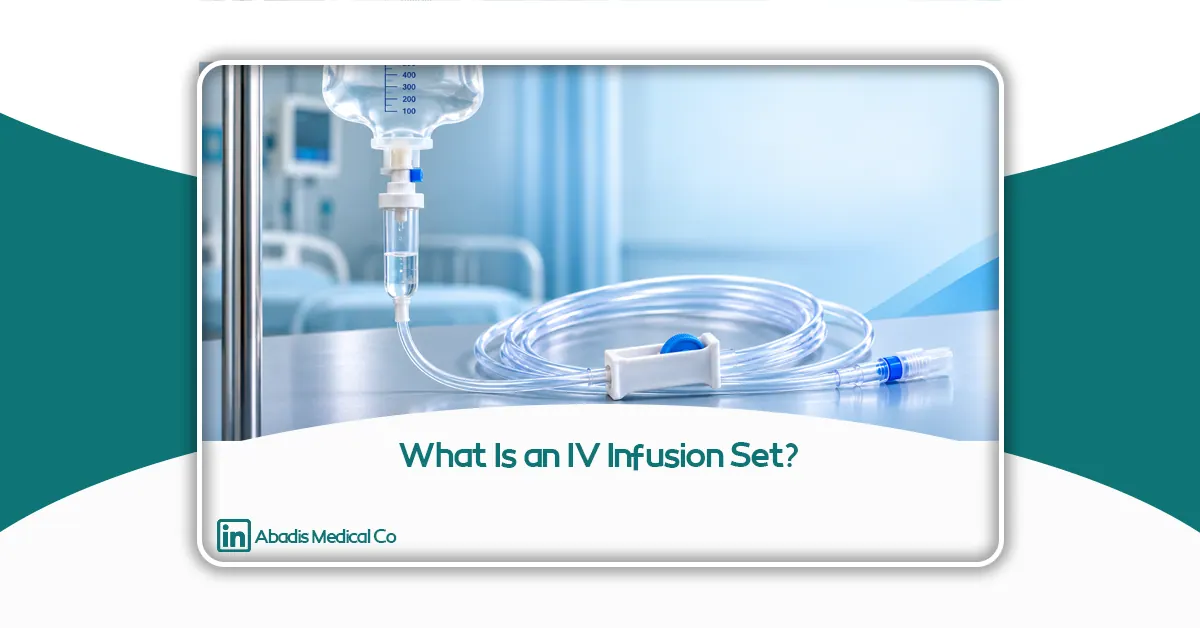
Intravenous (IV) infusion is one of the most widely used methods of administering fluids and medications in modern healthcare. From fluid replacement and electrolyte management to antibiotic administration and specialized medical treatments, intravenous therapy plays a vital role in hospitals, emergency departments, clinics, and other healthcare facilities.
An essential component of this process is the IV Infusion Set, also known as an IV Administration Set or IV Giving Set.
Although an infusion set may appear to be a relatively simple medical device, its design, material quality, component compatibility, and sterility are essential considerations for safe and effective fluid administration.
From a medical engineering perspective, an infusion set is more than a flexible tube. It is a system of interconnected components designed to transport fluids, regulate flow, maintain a closed fluid pathway, and support the safe administration of intravenous solutions.
According to the U.S. Food and Drug Administration (FDA), an intravascular administration set is a device used to administer fluids from a container to a patient’s vascular system through a needle or catheter. Depending on its design, the device may include tubing, a flow regulator, a drip chamber, filters, and connectors [1].
This article examines the structure, operating principles, different types, clinical applications, international standards, and safety considerations associated with IV infusion sets.
What Is an IV Infusion Set and How Does It Work?
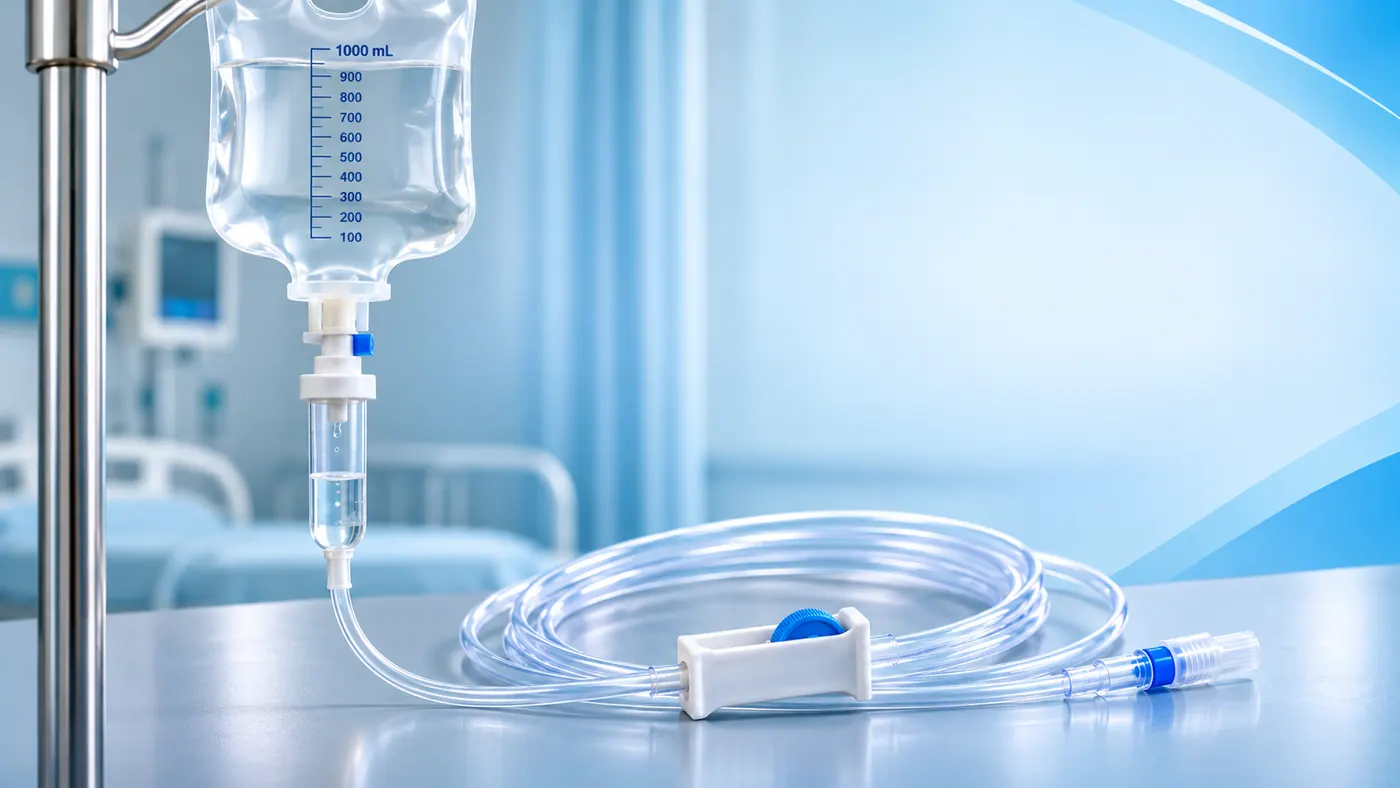
An intravenous infusion set is a medical device designed to transfer sterile fluids or medications from an infusion container into a patient’s vascular system.
A typical gravity-fed infusion set connects an IV fluid bag or bottle to the patient’s intravenous access device.
In gravity infusion systems, fluid movement is primarily driven by the pressure difference created by the height of the fluid container relative to the infusion site.
When the fluid container is positioned appropriately, the resulting hydrostatic pressure allows the solution to flow through the tubing toward the patient.
The flow rate depends on several factors, including:
- The height of the infusion container.
- The internal resistance of the tubing.
- The characteristics and viscosity of the solution.
- The position of the flow regulator.
- The condition of the intravenous access pathway.
A roller clamp is commonly used to adjust fluid flow by changing the degree of compression applied to the tubing.
However, gravity-based flow regulation does not provide the same level of precision as an electronic infusion pump.
For clinical situations requiring more accurate control over fluid volume and administration rate, compatible infusion pumps and dedicated administration sets may be necessary.
The FDA identifies infusion pumps as medical devices capable of delivering fluids and medications at controlled rates, while emphasizing the importance of proper operation, maintenance, and monitoring [2].
Main Components of an IV Infusion Set
The construction of an IV infusion set varies depending on its manufacturer, intended clinical application, and technical specifications.
Nevertheless, most conventional infusion sets contain several essential components.
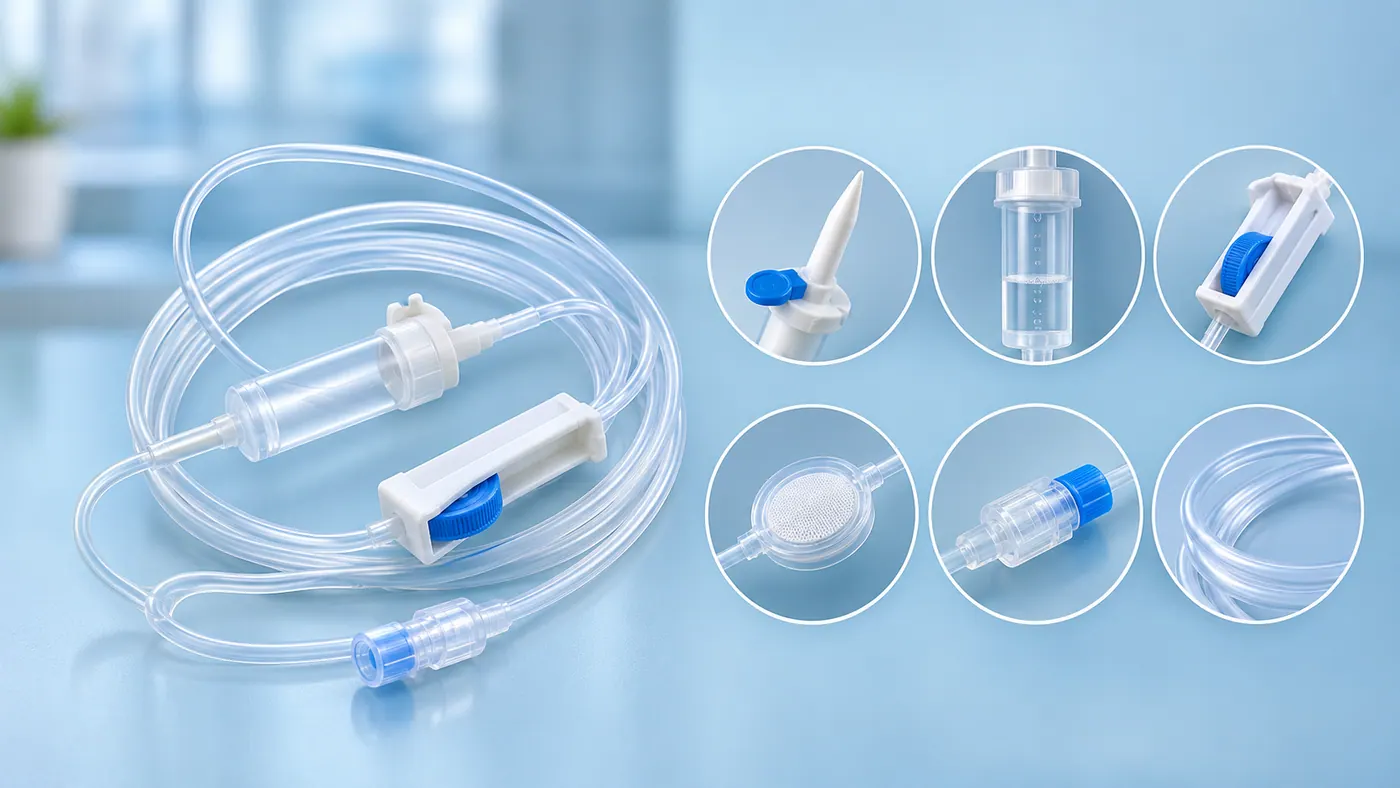
1. Spike – Connection to the IV Fluid Container
The spike is a component designed to establish a fluid connection between the infusion container and the administration set.
It is generally positioned at the beginning of the infusion pathway and is inserted into the designated port of a compatible IV fluid bag or bottle.
The spike must be properly designed to establish a secure connection and minimize the risk of fluid leakage.
Certain infusion sets include an air vent that allows air to enter containers requiring ventilation during fluid administration.
The need for a vented or non-vented system depends on the design of the infusion container and the manufacturer’s instructions.
2. Drip Chamber
The drip chamber is one of the most recognizable components of an IV infusion set.
It allows healthcare professionals to observe the movement of fluid droplets during gravity infusion.
In conventional gravity-fed systems, the chamber supports visual flow assessment and the estimation of administration rates through drop counting.
It also assists in managing air within the infusion pathway during preparation.
The volume represented by each drop depends on the design of the drip chamber and its specified drop factor.
Therefore, different infusion sets may generate different numbers of drops per milliliter.
The drop factor should always be verified using the information provided by the manufacturer.
3. Infusion Tubing
Infusion tubing provides the main pathway through which fluid travels from the infusion container toward the patient.
The tubing must have suitable physical and mechanical properties for its intended application.
Important characteristics include flexibility, resistance to deformation, mechanical integrity, and compatibility with the fluids or medications being administered.
Excessive bending, compression, or kinking may restrict fluid flow or cause an obstruction.
Consequently, tubing design and manufacturing quality are important factors in the overall performance of an infusion set.
Material compatibility is another significant consideration.
Certain drugs may interact with specific polymeric materials or become adsorbed onto the internal surface of administration tubing.
For this reason, the suitability of the infusion set should be assessed when administering medications with special compatibility requirements.
4. Roller Clamp – Flow Regulator
A roller clamp is a mechanical device used to regulate or stop the flow of fluid through the tubing.
It generally consists of a housing and a movable wheel that applies controlled compression to the flexible tube.
Changing the wheel position modifies the resistance to fluid flow.
An appropriately designed roller clamp should allow practical flow adjustment without causing unacceptable damage to the tubing.
However, manual adjustment using a roller clamp does not provide the same level of accuracy as a calibrated infusion pump.
For medications requiring highly precise delivery, the infusion method should be selected according to the applicable clinical protocol.
5. Luer Connector
The terminal connector establishes a connection between the infusion set and a compatible intravenous access device or accessory.
Luer Slip and Luer Lock connections are commonly found in medical fluid administration systems.
Luer Lock connections incorporate a locking mechanism designed to provide a secure connection between compatible components.
The selection of a connector depends on its intended application and compatibility with the rest of the medical system.
ISO 80369-7:2021 specifies dimensional and performance requirements for small-bore connectors used in intravascular and hypodermic applications [3].
6. Fluid Filter
Some IV infusion sets include integrated filters designed to retain certain particles within the fluid pathway.
Filter performance depends on factors such as pore size, filter materials, positioning, and intended application.
It is important to recognize that not all infusion-set filters are designed to remove microorganisms or provide comprehensive fluid purification.
Certain medications require filters with specific technical characteristics.
In such cases, the filter must be selected according to the medication manufacturer’s instructions and the relevant clinical requirements.
Types of IV Infusion Sets
Infusion sets can be classified according to their flow-control mechanism, structural characteristics, and intended use.
Understanding these differences is important for selecting suitable equipment for particular clinical applications.
Macrodrip Infusion Set
A macrodrip infusion set is commonly used for gravity-based administration of intravenous fluids.
These sets generally produce larger drops than microdrip systems.
Depending on the manufacturer and product design, common nominal drop factors include:
- 10 drops/mL
- 15 drops/mL
- 20 drops/mL
These values are examples rather than universal specifications.
The actual drop factor must always be confirmed using the product labeling.
Macrodrip sets are commonly associated with routine gravity infusion applications where larger fluid volumes may be administered.
Microdrip Infusion Set
Microdrip infusion sets are designed to produce smaller fluid droplets.
Many microdrip systems have a nominal drop factor of 60 drops per milliliter.
This characteristic can simplify certain gravity-flow calculations and may be useful when smaller fluid volumes are involved.
Microdrip systems may be used in selected pediatric applications or situations requiring relatively low gravity infusion rates.
However, a smaller drop size does not automatically guarantee accurate fluid delivery under all clinical conditions.
For high-risk medications or treatments requiring precise infusion rates, an appropriate infusion pump may be necessary.
Infusion Pump Administration Set
Infusion pump administration sets are designed for use with specific types or models of infusion pumps.
The mechanical characteristics of the tubing must be compatible with the pump’s operating mechanism.
Depending on the device, such characteristics may influence fluid delivery accuracy, occlusion detection, and other safety functions.
Using an incompatible administration set may result in incorrect delivery volumes or other performance problems.
Therefore, compatibility should always be confirmed according to the pump manufacturer’s instructions.
Filtered Infusion Set
A filtered infusion set incorporates a filter designed for a particular fluid administration requirement.
Such sets may be used when a medication or infusion solution requires filtration with defined characteristics.
The filter’s pore size and material properties must be appropriate for the intended clinical application.
A filtered infusion set should not be assumed suitable for every medication requiring filtration.
Comparison of IV Infusion Set Types
| Type | Main Characteristics | Common Applications |
|---|---|---|
| Macrodrip Set | Larger drops; different nominal drop factors | General gravity infusion |
| Microdrip Set | Smaller drops; commonly 60 drops/mL | Selected low-volume infusion applications |
| Infusion Pump Set | Designed for compatible infusion pumps | Controlled fluid administration |
| Filtered Infusion Set | Incorporates a filter with specified properties | Infusions requiring filtration |
The appropriate system should be selected based on clinical requirements and the manufacturer’s technical documentation.
Clinical Applications of IV Infusion Sets
IV infusion sets are used across numerous healthcare environments.
Their principal purpose is to support the administration of compatible intravenous solutions and medications.
Fluid Replacement Therapy
Intravenous fluid therapy may be prescribed for patients experiencing dehydration, fluid loss, or other conditions requiring fluid administration.
The type, volume, and rate of fluid delivery are determined according to the patient’s clinical condition and treatment plan.
Intravenous Medication Administration
Many medications, including certain antibiotics, are administered intravenously.
Infusion sets provide the fluid pathway required to deliver these medications through an established intravenous access device.
Before administration, healthcare professionals must confirm the compatibility of the medication, dilution solution, and administration equipment.
Postoperative Care
Patients recovering from surgical procedures may require intravenous fluids, analgesics, antibiotics, or other prescribed medications.
Infusion equipment supports these treatments as part of postoperative care.
Intensive Care Units
In intensive care units, infusion systems are essential components of medication and fluid management.
Certain medications administered in critical care require highly controlled delivery rates.
For such applications, suitable infusion pumps and dedicated administration sets may be used.
Outpatient and Home Infusion Therapy
Some intravenous therapies are provided in outpatient facilities or at home under defined medical supervision.
The selection of appropriate equipment, proper training, and compliance with clinical protocols are essential in these settings.
It should be emphasized that a conventional IV infusion set is not necessarily suitable for blood transfusion, all specialty medications, or every type of infusion.
These applications may require dedicated administration systems.
International Standards for IV Infusion Sets
Because infusion sets are used in fluid pathways connected to the patient’s vascular system, their design and manufacturing processes must address relevant safety and performance requirements.
Several international standards provide important technical frameworks for these medical devices.
ISO 8536-4: Infusion Sets for Single Use, Gravity Feed
One of the most important product-specific standards is ISO 8536-4:2019.
Its title is:
Infusion equipment for medical use — Part 4: Infusion sets for single use, gravity feed.
This standard specifies requirements for single-use gravity-fed infusion sets intended for medical applications.
It addresses product characteristics and requirements intended to support compatibility and functional performance.
ISO 8536-4:2019 is an important technical reference for manufacturers and organizations evaluating gravity infusion equipment [4].
ISO 8536-8: Infusion Sets for Pressure Infusion Equipment
ISO 8536-8:2015 addresses single-use infusion sets intended for pressure infusion equipment within the scope defined by the standard.
The standard is not automatically applicable to every infusion set.
Its relevance must be determined according to the product design and intended use [5].
ISO 80369-7: Small-Bore Connectors
ISO 80369-7:2021 specifies requirements for connectors used in intravascular and hypodermic applications.
Appropriate connector design contributes to the functional compatibility of medical devices and supports the management of risks associated with incorrect connections.
Manufacturers must evaluate connector performance in relation to the intended medical application [3].
ISO 13485: Medical Device Quality Management Systems
ISO 13485:2016 establishes requirements for quality management systems used by organizations involved in the medical device industry.
For infusion set manufacturers, a quality management system may support:
- Control of raw materials and purchased components.
- Validation of relevant manufacturing processes.
- Product identification and traceability.
- Management of nonconforming products.
- Complaint handling and corrective actions.
- Monitoring of post-market feedback.
However, ISO 13485 certification alone does not establish that an individual product complies with every applicable product-specific standard.
How to Select a High-Quality IV Infusion Set
Selecting an infusion set should involve more than comparing product prices or visual appearance.
Healthcare procurement professionals should evaluate several technical and quality-related factors.
Compatibility with the intended application is one of the most important considerations.
The product’s design, drop factor, tubing characteristics, connectors, and compatibility with the fluid container must meet the intended clinical requirements.
For pump-based administration, compatibility with the specific infusion pump should also be confirmed.
Sterile barrier integrity is another essential consideration.
Products labeled as sterile should have packaging designed to maintain the required sterile condition until the point of use, provided that storage and handling conditions are followed.
The packaging should be inspected before use.
Connection integrity is also significant. Poorly designed or incompatible connectors may increase the risk of leakage or unintentional disconnection.
Tubing quality should be assessed in relation to flexibility, mechanical strength, resistance to kinking, and compatibility with relevant medications.
Product traceability is especially important in hospital procurement.
Relevant information may include the manufacturer’s identification, lot or batch number, expiration date, and applicable product specifications.
Such information supports inventory management, complaint investigations, and potential medical device recalls.
Healthcare organizations should also verify the regulatory documentation and market authorization requirements applicable in their jurisdiction.
Safe Use of IV Infusion Sets
IV infusion sets should be prepared and used by appropriately trained healthcare personnel in accordance with clinical prescriptions, institutional protocols, and manufacturer instructions.
Before use, the healthcare professional should check the packaging, expiration date, intended application, and compatibility of the administration set.
Hand hygiene and aseptic technique are essential during preparation and connection.
The Centers for Disease Control and Prevention (CDC) emphasizes that infusion equipment, including fluid containers, tubing, and connectors, should be used for only one patient [6].
Before connecting the system to the patient, the fluid pathway must be prepared according to the product instructions, including appropriate management of air within the tubing.
Following connection, the prescribed fluid administration rate must be established using the appropriate infusion method.
During administration, healthcare professionals should monitor the infusion pathway for signs of leakage, obstruction, disconnection, or other abnormalities.
The intravenous access site should also be monitored for relevant clinical complications.
If a problem occurs, appropriate intervention should be performed by qualified personnel.
Improper manipulation of the equipment may introduce additional risks.
Potential Risks Associated with Improper Infusion Set Use
Although infusion sets are widely used in clinical practice, inappropriate selection, handling, or operation may contribute to complications.
Microbial Contamination and Infection
Contamination can occur when sterile components contact contaminated surfaces or when appropriate aseptic practices are not followed.
Reusing disposable equipment or sharing infusion components between patients may create additional infection risks.
CDC guidance emphasizes aseptic preparation and patient-specific use of infusion equipment [6].
Air Entering the Infusion Pathway
Air entering the vascular system is a recognized potential risk of intravenous therapy.
The clinical consequences depend on several factors, including the amount of air introduced, the rate of entry, and the patient’s condition.
Correct preparation of the infusion pathway and the use of appropriate equipment are therefore important safety measures.
Flow Obstruction
Kinking of the tubing, closure of the flow regulator, or obstruction elsewhere in the fluid pathway may reduce or interrupt infusion flow.
The cause of an obstruction must be identified and addressed appropriately.
Incorrect Infusion Rate
Delivering fluids or medications faster or slower than prescribed may affect treatment effectiveness or patient safety.
The FDA identifies issues such as uncontrolled flow, occlusion, and delivery inaccuracies among important safety concerns associated with infusion systems [7].
Material and Medication Incompatibility
Not all infusion sets are suitable for every medication or solution.
Some medications require particular tubing materials, filters, or administration conditions.
Healthcare professionals should consult the relevant drug information and device instructions before administration.
When Should an IV Infusion Set Be Replaced?
The appropriate replacement interval depends on the type of infusion, the fluids being administered, the clinical circumstances, and applicable infection prevention guidelines.
According to CDC recommendations, administration sets used continuously in patients who are not receiving blood, blood products, or fat emulsions should generally not be replaced more frequently than every 96 hours, but should be replaced at least every seven days.
For administration sets used with blood, blood products, or fat emulsions, the CDC recommends replacement within 24 hours of initiating the infusion.
Certain medications, including propofol, have specific administration set replacement requirements [8].
These recommendations do not authorize the reuse of single-use infusion sets.
Earlier replacement may be necessary if the equipment becomes contaminated, damaged, disconnected, or otherwise unsuitable for continued use.
The device manufacturer’s instructions and institutional policies must also be considered.
What Is the Difference Between an IV Infusion Set and an Extension Tube?
IV infusion sets and extension tubes may both form part of intravenous fluid administration systems, but they serve different purposes.
An IV infusion set typically contains several functional components required to transfer fluid from the original infusion container.
Depending on its design, these components may include a spike, drip chamber, tubing, flow regulator, and terminal connector.
An extension tube, also called an IV extension line, is primarily designed to extend the length of a compatible fluid administration pathway or provide a connection between designated medical components.
An extension tube generally does not replace the complete functionality of an infusion set unless the medical system has been specifically designed for such a configuration.
Understanding this distinction is important for healthcare professionals and medical equipment procurement specialists.
Incorrect selection of components may lead to incompatibility or difficulties during medical treatment.
The Role of Quality Management in Infusion Equipment Manufacturing
Manufacturing disposable medical devices requires controlled processes designed to support consistent product quality and performance.
For infusion sets, quality evaluation extends beyond visual inspection.
Depending on the product design and applicable standards, relevant testing may include assessments of:
- Leakage resistance.
- Flow performance.
- Mechanical integrity.
- Connector strength and functionality.
- Physical properties of materials.
- Packaging integrity.
Manufacturers must also identify and evaluate risks associated with the intended use of their products.
Risk management activities may address potential hazards such as fluid leakage, contamination, incorrect connections, obstruction, and reasonably foreseeable misuse.
Post-market activities are equally important.
Customer feedback, complaint investigation, product performance monitoring, and corrective actions help manufacturers identify potential issues after products enter clinical use.
This systematic approach supports continuous improvement and the ongoing evaluation of medical device safety.
The Importance of Choosing Reliable Medical Equipment
Disposable medical devices account for a significant proportion of the equipment used in daily hospital operations.
Although their individual purchase prices may be relatively low compared with advanced medical devices, their frequent use and importance in clinical procedures make product selection a significant responsibility.
Medical equipment evaluation should consider patient safety, manufacturing quality, functional consistency, traceability, and supply reliability.
Inadequate product performance may increase waste, result in premature equipment replacement, or disrupt healthcare workflows.
Medical device companies, including ABADIS MED, contribute to the healthcare supply chain through the development and provision of medical consumables and solutions related to fluid and secretion management.
Understanding the technical requirements and international standards associated with medical fluid administration equipment helps healthcare organizations make more informed procurement decisions.
Conclusion
IV infusion sets are essential medical devices used to support intravenous fluid and medication administration.
Their performance depends on appropriate design, material quality, component compatibility, and compliance with relevant safety requirements.
Understanding the differences between macrodrip, microdrip, pump-compatible, and filtered administration sets helps healthcare professionals select equipment suited to specific clinical applications.
International standards, including ISO 8536-4 and ISO 80369-7, provide important technical references for evaluating the design and performance of these products.
Safe clinical use also requires proper preparation, aseptic technique, patient-specific equipment, and adherence to appropriate administration set replacement recommendations.
Ultimately, selecting reliable medical equipment based on documented technical characteristics, applicable standards, and clinical requirements supports patient safety, healthcare quality, and more effective medical supply management.
Scientific References
- U.S. Food and Drug Administration / Electronic Code of Federal Regulations. 21 CFR § 880.5440 – Intravascular Administration Set.
https://www.ecfr.gov/current/title-21/section-880.5440 - U.S. Food and Drug Administration. Infusion Pumps – General Hospital Devices and Supplies.
https://www.fda.gov/medical-devices/general-hospital-devices-and-supplies/infusion-pumps - International Organization for Standardization. ISO 80369-7:2021 – Small-Bore Connectors for Intravascular or Hypodermic Applications.
https://www.iso.org/standard/79173.html - International Organization for Standardization. ISO 8536-4:2019 – Infusion Sets for Single Use, Gravity Feed.
https://www.iso.org/standard/70730.html - International Organization for Standardization. ISO 8536-8:2015 – Infusion Sets for Single Use with Pressure Infusion Apparatus.
https://www.iso.org - Centers for Disease Control and Prevention. Safe Injection Practices to Prevent Transmission of Infections to Patients.
https://www.cdc.gov/injection-safety/hcp/clinical-guidance/ - U.S. Food and Drug Administration. Infusion Pumps Total Product Life Cycle – Guidance for Industry and FDA Staff. 2014.
https://www.fda.gov/regulatory-information/search-fda-guidance-documents/infusion-pumps-total-product-life-cycle - Centers for Disease Control and Prevention. Guidelines for the Prevention of Intravascular Catheter-Related Infections – Replacement of Administration Sets.
https://www.cdc.gov/infection-control/hcp/intravascular-catheter-related-infection/prevention-strategies.html