

What Is a Microdrip Infusion Set? A Complete Guide to Components, Applications, Drop Rate Calculations, and Differences from Macrodrip Sets
Introduction
Intravenous (IV) fluid and medication administration is an essential part of modern healthcare. It is used in emergency departments, intensive care units, pediatric wards, neonatal care facilities, and other clinical settings.
During intravenous therapy, controlling the volume and rate of fluid administration is particularly important. Delivering more or less fluid than prescribed may affect treatment effectiveness and patient safety.
One of the medical devices used for gravity-based intravenous administration is the microdrip infusion set, commonly referred to as a microdrip set or microdrip IV administration set.
A microdrip set is designed to produce relatively small drops of fluid, allowing healthcare professionals to calculate and adjust gravity infusion rates using a specified drop factor.
Microdrip sets are particularly associated with pediatric and neonatal care, where smaller fluid volumes may be required. However, their use is not limited exclusively to children.
Despite its relatively simple appearance, a microdrip infusion set consists of several functional components. Its performance depends on drip chamber design, tubing characteristics, connector compatibility, flow resistance, and appropriate clinical use.
Understanding the components, operating principles, applications, international standards, and limitations of microdrip infusion sets is important for healthcare professionals, biomedical engineers, and medical equipment procurement specialists.
This article provides a scientific and practical overview of microdrip infusion sets and explains how they differ from conventional macrodrip systems.
What Is a Microdrip Infusion Set?
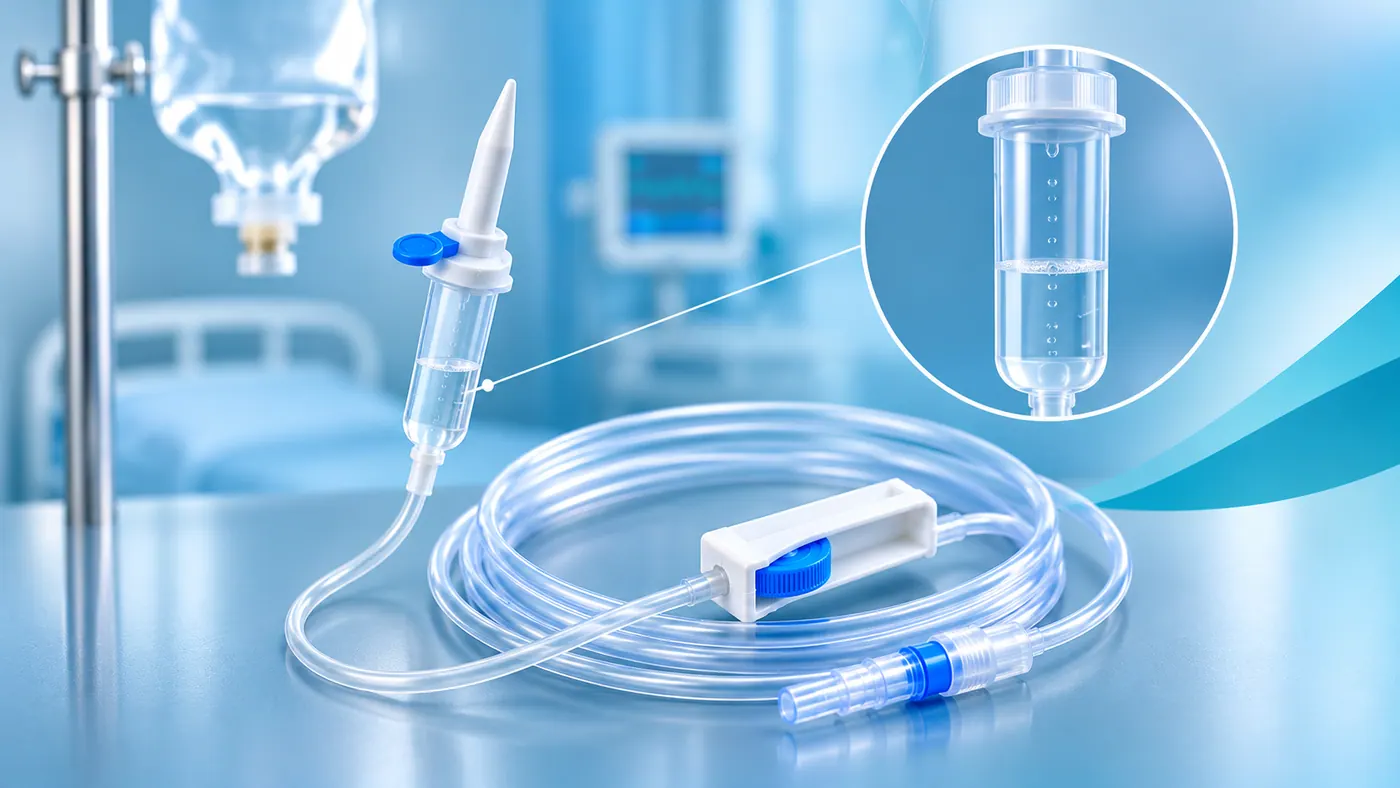
A microdrip infusion set is a type of intravenous administration set designed to transfer fluids from an infusion container into a patient’s intravenous access system.
Its defining characteristic is a drip chamber designed to produce small drops with a relatively high nominal drop factor.
Most conventional microdrip sets have a drop factor of 60 drops per milliliter (60 gtt/mL).
This means that, under the specified conditions, approximately 60 drops correspond to one milliliter of fluid.
By comparison, macrodrip infusion sets commonly have drop factors of 10, 15, or 20 drops per milliliter, depending on the product design.
The drop factor is an essential parameter in gravity infusion calculations and is generally provided on the infusion set packaging.
According to the Open RN Nursing Skills educational resource available through NCBI Bookshelf, microdrip tubing commonly has a drop factor of 60 drops/mL and may be used in situations involving the administration of relatively small fluid volumes, particularly in pediatric care [1].
However, producing smaller drops does not automatically guarantee more accurate fluid delivery under all clinical conditions.
Microdrip sets remain subject to variations in hydrostatic pressure, tubing resistance, patient movement, and other factors that influence gravity infusion.
How Does a Microdrip Infusion Set Work?
A conventional microdrip infusion set generally operates through gravity.
When the infusion container is positioned above the patient’s intravenous access site, the resulting hydrostatic pressure allows the solution to move through the administration system.
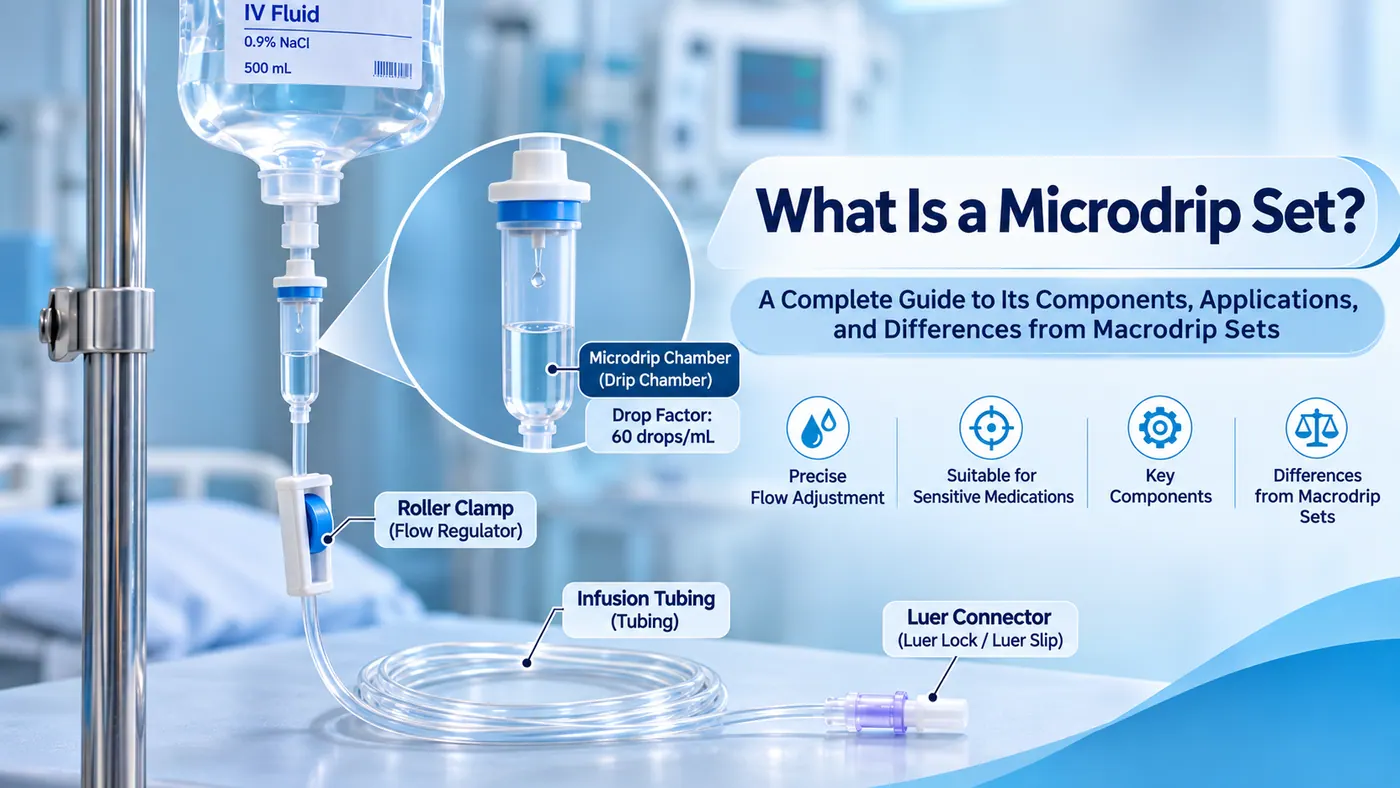
Fluid enters the drip chamber through an inlet designed to produce relatively small droplets.
The drops then collect in the chamber before the fluid continues through the administration tubing toward the patient.
A mechanical flow regulator, typically a roller clamp, is used to adjust the resistance within the tubing.
Changing the roller clamp position affects the fluid flow rate.
Healthcare professionals may estimate the delivery rate by counting the number of drops entering the drip chamber during a specified period.
However, the actual flow rate may change during administration.
Factors influencing gravity infusion include:
- Height of the infusion container.
- Resistance within the intravenous pathway.
- Tubing kinking or compression.
- Characteristics of the administered solution.
- Changes in patient position.
- Adjustment or movement of the roller clamp.
Therefore, microdrip infusion requires appropriate monitoring and should not be considered equivalent to electronically controlled infusion.
Main Components of a Microdrip Infusion Set
A microdrip infusion set contains multiple components designed to support fluid transfer and regulation.
The exact configuration depends on the manufacturer and intended application.
1. Spike – Connection to the Infusion Container
The spike establishes a connection between the infusion container and the administration set.
It is designed to be inserted into the appropriate port of a compatible IV fluid bag or bottle.
The spike should provide a secure connection while minimizing the possibility of fluid leakage.
Some designs include an air vent to support fluid administration from containers requiring ventilation.
Whether a vented or non-vented configuration is appropriate depends on the infusion container and the manufacturer’s instructions.
2. Microdrip Chamber
The drip chamber is one of the most important components of a microdrip infusion set.
In conventional microdrip systems, its design produces a nominal drop factor of 60 drops per milliliter.
The chamber allows healthcare professionals to observe fluid movement and count drops during gravity infusion.
It also plays a role in managing air within the fluid pathway during preparation.
The specified drop factor should be confirmed on the product labeling before calculating an infusion rate.
3. Infusion Tubing
Infusion tubing forms the primary pathway for fluid transportation.
It should provide suitable flexibility, mechanical strength, and resistance to deformation for the intended application.
Excessive bending, compression, or kinking may interfere with the movement of fluid.
The chemical compatibility of tubing materials is also important.
Certain medications may interact with specific polymeric materials or become adsorbed onto the internal surface of the tubing.
For medications with special compatibility requirements, the administration set should be selected according to the relevant technical information.
4. Roller Clamp – Flow Regulator
The roller clamp is a mechanical component used to regulate or stop fluid flow.
It typically includes a housing and a movable wheel that compresses the flexible tubing.
Changing the wheel position modifies the resistance to fluid movement.
A properly designed roller clamp should allow practical flow adjustment without causing unacceptable damage to the tubing.
Nevertheless, a mechanical roller clamp cannot guarantee a constant infusion rate under every clinical condition.
5. Graduated Chamber in Selected Designs
Some low-volume infusion administration sets include a graduated chamber or burette.
This chamber allows a specified volume of fluid to be prepared for administration.
An important distinction is that a 60-drop/mL microdrip set and a burette administration set are not necessarily the same medical device.
Some products may incorporate both features, but a graduated chamber is not a universal component of all microdrip sets.
Its presence and capacity should be verified through the manufacturer’s specifications.
6. Luer Connector
The terminal connector establishes a connection with compatible intravenous equipment.
Luer Slip and Luer Lock connectors are commonly used in medical fluid administration systems.
ISO 80369-7:2021 specifies dimensional and functional performance requirements for small-bore connectors used in intravascular and hypodermic applications [2].
Appropriate connector compatibility helps reduce problems associated with unsuitable connections.
7. Fluid Filter
Certain infusion sets incorporate filters within the fluid pathway.
Depending on their design, these filters may be intended to retain specified particles.
Filter characteristics such as pore size, material, and fluid compatibility must be appropriate for the intended application.
The presence of a filter does not necessarily mean that the infusion set can remove all microorganisms or provide complete fluid purification.
Microdrip vs. Macrodrip: What Is the Difference?
Microdrip and macrodrip infusion sets are both used for intravenous fluid administration.
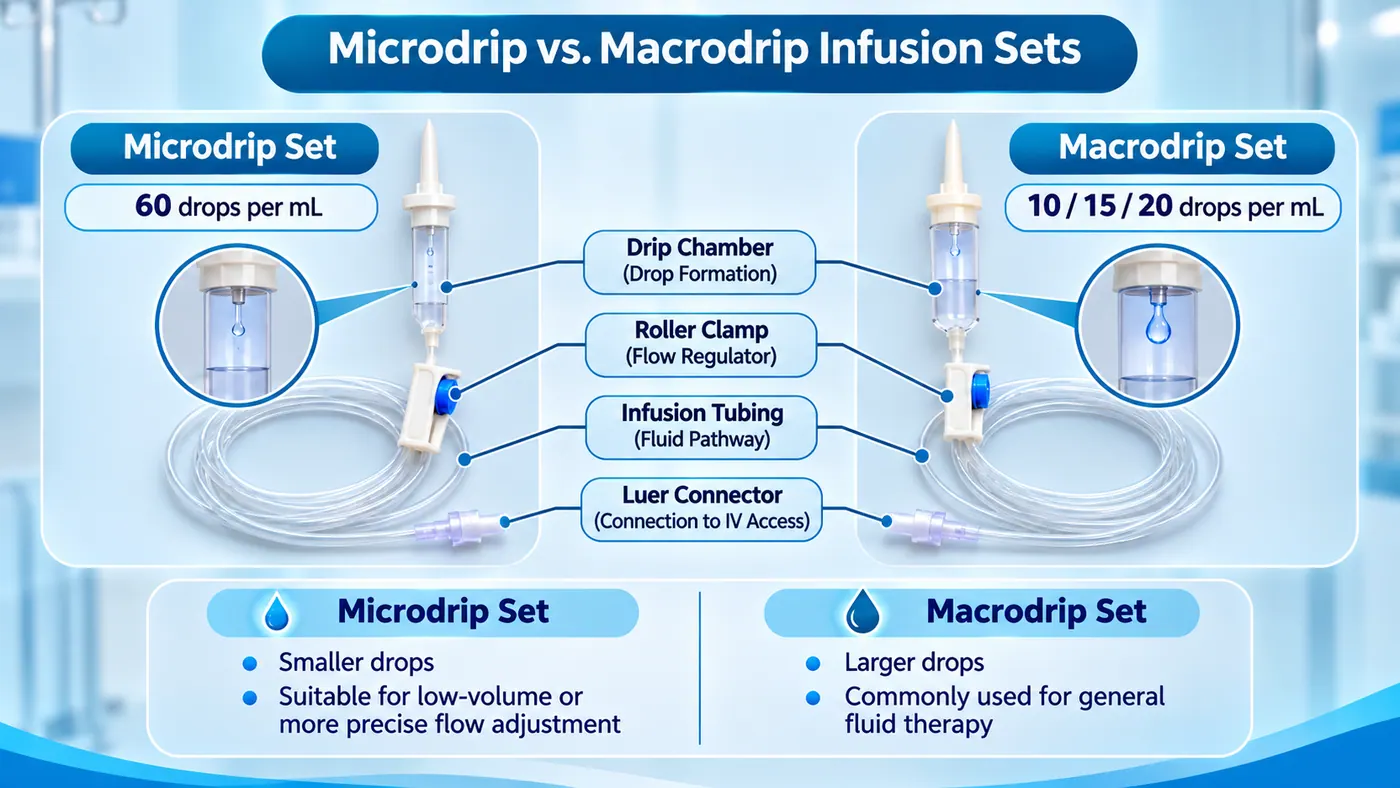
Their primary difference is the nominal drop factor and the resulting size of individual drops.
A conventional microdrip set typically produces 60 drops per milliliter.
Macrodrip systems generally produce fewer, larger drops per milliliter.
This difference influences the relationship between the prescribed fluid rate and the number of drops that must be counted during gravity infusion.
Microdrip vs. Macrodrip Comparison
| Feature | Microdrip Set | Macrodrip Set |
|---|---|---|
| Drop Factor | Usually 60 gtt/mL | Commonly 10, 15, or 20 gtt/mL |
| Drop Size | Smaller | Larger |
| Common Applications | Selected low-volume infusions | General gravity fluid administration |
| Pediatric Applications | Common in selected situations | Depends on clinical requirements |
| Flow Calculation | Simplified by the 60 gtt/mL factor | Depends on the labeled drop factor |
| Guaranteed Delivery Accuracy | No | No |
| Flow Monitoring Required | Yes | Yes |
The selection of an administration set should be based on the prescribed treatment, patient condition, equipment compatibility, and clinical protocols.
Clinical Applications of Microdrip Infusion Sets
Microdrip sets are commonly associated with situations in which relatively small fluid volumes are administered through gravity.
Neonatal Care
Newborn infants have specific physiological characteristics and fluid requirements.
In selected clinical circumstances, microdrip systems may be used for low-volume gravity infusion.
However, critically ill newborns or patients requiring highly controlled fluid administration may need appropriately selected infusion pumps.
Pediatric Care
In pediatric medicine, fluid and medication requirements are often determined according to body weight and clinical condition.
A drop factor of 60 gtt/mL can simplify certain gravity infusion calculations.
Nevertheless, the choice of equipment depends on the medication, prescribed volume, required accuracy, and clinical circumstances.
Low-Volume Infusions
Some treatments require relatively small amounts of fluid to be administered over a defined period.
A microdrip set may be suitable when gravity infusion is clinically appropriate.
However, it should not be assumed that every low-volume infusion can be administered safely using a manually regulated microdrip set.
General Hospital and Outpatient Care
Microdrip sets may also be used in hospital wards and outpatient settings for selected intravenous treatments.
Compatibility with the prescribed fluid, medication, and access device must be verified.
Intensive Care Units
Accurate medication and fluid administration is particularly important in critical care.
Although microdrip systems may be used in specific circumstances, gravity-based microdrip administration is not a general replacement for infusion pumps when precise control is required.
How to Calculate the Microdrip Infusion Rate
One of the practical advantages of a conventional 60 gtt/mL microdrip set is the simplicity of its flow-rate calculations.
The formula for calculating drops per minute is:
Drops/min = (Volume in mL × Drop Factor in gtt/mL) ÷ Infusion Time in Minutes
This formula is described in standard nursing calculation resources [1].
Example 1: Administering 120 mL Over Two Hours
Suppose 120 mL of fluid has been prescribed over 120 minutes using a microdrip set with a drop factor of 60 gtt/mL.
Calculation:
(120 × 60) ÷ 120 = 60
Result: 60 drops per minute.
Example 2: Administering 50 mL Over One Hour
Infusion volume: 50 mL
Infusion time: 60 minutes
Drop factor: 60 gtt/mL
Calculation:
(50 × 60) ÷ 60 = 50
Result: 50 drops per minute.
Example 3: Administering 30 mL Over Three Hours
Infusion volume: 30 mL
Infusion time: 180 minutes
Drop factor: 60 gtt/mL
Calculation:
(30 × 60) ÷ 180 = 10
Result: 10 drops per minute.
These examples are intended for educational purposes and do not represent patient-specific prescriptions.
Quick Reference: Microdrip Flow Calculations
For a microdrip set with a nominal drop factor of 60 gtt/mL:
| Prescribed Flow Rate | Theoretical Drop Rate |
|---|---|
| 5 mL/hour | 5 drops/min |
| 10 mL/hour | 10 drops/min |
| 20 mL/hour | 20 drops/min |
| 30 mL/hour | 30 drops/min |
| 40 mL/hour | 40 drops/min |
| 50 mL/hour | 50 drops/min |
| 60 mL/hour | 60 drops/min |
| 100 mL/hour | 100 drops/min |
Because the drop factor is 60 drops/mL, the numerical value of the flow rate in mL/hour equals the theoretical number of drops per minute.
This relationship is a mathematical convenience, not a guarantee of actual infusion accuracy.
Is a Microdrip Set More Accurate Than a Macrodrip Set?
This is one of the most important questions regarding microdrip administration.
Because microdrip sets produce smaller drops, they provide smaller nominal volume increments during drop counting.
However, smaller drops do not automatically result in more accurate fluid delivery under all conditions.
Gravity infusion rates can fluctuate due to changes in hydrostatic pressure, tubing resistance, roller clamp position, and patient movement.
Human errors in counting drops or adjusting the flow regulator may also influence the actual delivery rate.
Therefore, the nominal drop factor alone is insufficient to establish the clinical accuracy of an infusion system.
When the prescribed treatment requires highly accurate delivery, appropriately selected electronic infusion equipment may be necessary.
International Standards for Microdrip Infusion Sets
Microdrip infusion sets are medical devices and must satisfy the relevant requirements associated with their intended use.
Several international standards provide important technical references for their design, production, and evaluation.
ISO 8536-4:2019 – Single-Use Gravity Infusion Sets
ISO 8536-4:2019 is titled:
Infusion Equipment for Medical Use — Part 4: Infusion Sets for Single Use, Gravity Feed.
This standard specifies requirements for single-use gravity-fed infusion sets.
It addresses compatibility with infusion solution containers and intravenous equipment, together with relevant material and performance considerations.
The 2019 edition was reviewed and confirmed in 2025 and remains the published edition as of November 2026 [3].
ISO 80369-7:2021 – Small-Bore Connectors
This standard specifies dimensional and functional requirements for small-bore connectors used in intravascular and hypodermic applications.
It is particularly relevant to appropriate Luer connections in compatible medical equipment.
The standard supports the management of risks associated with connector design and performance [2].
ISO 13485:2016 – Medical Device Quality Management Systems
ISO 13485 establishes requirements for quality management systems used by organizations operating in the medical device industry.
For manufacturers of disposable infusion equipment, a quality management system may support:
- Raw material control.
- Manufacturing process validation.
- Product identification and traceability.
- Nonconforming product management.
- Complaint investigation.
- Corrective and preventive actions.
ISO 13485 certification does not, by itself, establish compliance with every product-specific standard.
ISO 14971:2019 – Risk Management for Medical Devices
ISO 14971 provides a framework for applying risk management to medical devices.
For a microdrip infusion set, risk management may involve evaluating potential hazards such as leakage, contamination, tubing obstruction, incompatible connections, and uncontrolled fluid delivery.
Manufacturers should assess these risks according to the device’s intended use and reasonably foreseeable misuse.
Safety Considerations When Using a Microdrip Set
Microdrip infusion sets should be prepared and used by trained healthcare personnel according to the prescribed treatment, manufacturer instructions, and institutional protocols.
Before use, the packaging integrity, expiration date, product specifications, and equipment compatibility should be checked.
Appropriate hand hygiene and aseptic technique are essential during preparation and connection.
The Centers for Disease Control and Prevention (CDC) emphasizes that infusion equipment, including fluid bags, tubing, and connectors, must be used for only one patient [4].
The fluid pathway should be prepared according to the manufacturer’s instructions, including appropriate management of air within the tubing.
During infusion, healthcare professionals should monitor the flow rate and intravenous access site.
Potential problems include leakage, flow interruption, obstruction, or abnormalities at the access site.
Any such problem requires appropriate clinical evaluation.
When Should a Microdrip Set Be Replaced?
Administration set replacement intervals depend on the fluids being administered, the clinical conditions, and infection prevention guidelines.
According to CDC recommendations, continuously used administration sets in patients who are not receiving blood, blood products, or fat emulsions should generally not be replaced more frequently than every 96 hours, but should be replaced at least every seven days.
Administration tubing used for blood, blood products, or fat emulsions should be replaced within 24 hours of initiating the infusion.
Certain medications, including propofol, have additional replacement requirements [5].
These recommendations do not permit the reuse of single-use infusion sets.
Manufacturer instructions and institutional infection prevention policies must also be considered.
How to Choose a High-Quality Microdrip Infusion Set
Selecting an appropriate microdrip set requires the evaluation of several technical characteristics.
Drop Factor: The nominal drop factor must be clearly identified and appropriate for the intended application.
Tubing Quality: The tubing should demonstrate suitable flexibility, mechanical strength, and resistance to kinking.
Drip Chamber Performance: The chamber should operate according to the specifications defined by the manufacturer.
Connector Compatibility: The terminal connector must be compatible with the other components of the intravenous administration system.
Sterile Packaging: Sterile barrier integrity and appropriate storage conditions should be verified.
Traceability: Information such as batch number, manufacturer identification, and expiration date supports quality management.
Technical Documentation: Applicable standards, product testing documentation, and relevant regulatory authorizations should be reviewed.
Healthcare organizations may also consider supply reliability, quality consistency, and the manufacturer’s ability to respond to complaints or technical inquiries.
The Role of Quality Control in Microdrip Set Manufacturing
The manufacturing of microdrip infusion sets requires careful control over materials, components, and production processes.
Depending on the product design and applicable standards, quality control activities may include evaluations of:
- Fluid leakage.
- Drip chamber functionality.
- Fluid flow performance.
- Connector strength.
- Tubing integrity.
- Packaging performance.
For products supplied sterile, appropriate sterilization process validation and sterile barrier management are essential.
Manufacturers must also establish suitable product traceability processes.
Complaint investigation, analysis of customer feedback, and implementation of corrective actions contribute to continuous quality improvement.
These activities are particularly important for frequently used disposable medical devices, where consistent performance across production batches is necessary.
The Importance of Medical Fluid Administration Equipment in Patient Safety
The quality and compatibility of medical equipment are important considerations in the safe administration of intravenous fluids.
Appropriate device selection, infection prevention practices, and monitoring procedures can help reduce avoidable risks.
Healthcare organizations must also consider procurement quality, inventory management, and the reliability of their medical equipment suppliers.
Medical device manufacturers, including ABADIS MED, contribute to healthcare supply chains through the development and provision of medical consumables and solutions associated with fluid and secretion management.
Understanding devices such as microdrip infusion sets, conventional IV administration sets, extension tubing, and fluid transfer accessories helps healthcare professionals and procurement specialists make informed equipment decisions.
Frequently Asked Questions About Microdrip Infusion Sets
1. How Many Drops per Minute Does a Microdrip Set Deliver?
A microdrip set does not have one fixed flow rate.
For a conventional 60 gtt/mL set, the theoretical number of drops per minute equals the numerical value of the prescribed flow rate in milliliters per hour.
2. How Many Drops Are in One Milliliter in a Microdrip Set?
Most conventional microdrip sets have a nominal drop factor of 60 drops per milliliter.
However, the actual product specifications must always be verified.
3. What Is the Main Difference Between Microdrip and Macrodrip Sets?
The principal difference is the drop factor.
Microdrip sets commonly produce 60 drops/mL, whereas macrodrip sets typically produce fewer drops per milliliter.
4. Are Microdrip Sets Used Only for Children?
No. Microdrip sets may be used in selected low-volume infusion applications involving different patient populations.
However, they are particularly associated with certain pediatric and neonatal applications.
5. Is a Microdrip Set More Accurate Than an Infusion Pump?
No. A conventional gravity-fed microdrip set does not electronically control the infusion rate.
It should not replace an appropriate infusion pump when highly accurate delivery is required.
6. Are Microdrip Infusion Sets Disposable?
Many microdrip infusion sets are manufactured as sterile, single-use medical devices.
Products labeled for single use should not be reused.
7. Does Every Microdrip Set Have a Graduated Chamber?
No. Some administration sets include a graduated chamber or burette, but this is not a universal feature of microdrip infusion sets.
8. What Is the Main International Standard for Microdrip Infusion Sets?
ISO 8536-4:2019 is an important standard for single-use gravity-fed infusion sets within its defined scope.
Other standards may apply depending on product design and intended use.
Conclusion
Microdrip infusion sets are medical devices used for intravenous fluid administration, particularly in selected situations requiring the gravity delivery of relatively small fluid volumes.
Their defining feature is a high nominal drop factor, commonly 60 drops per milliliter, which enables smaller droplets and simplifies certain infusion calculations.
Understanding their components, clinical applications, differences from macrodrip systems, and limitations is essential for appropriate equipment selection.
However, smaller drop size does not automatically guarantee greater clinical accuracy.
Compliance with applicable international standards, appropriate manufacturing quality control, safe preparation, and careful clinical monitoring remain important factors in intravenous therapy.
Ultimately, a scientific understanding of microdrip infusion sets supports better decision-making among healthcare professionals, biomedical engineers, and medical equipment procurement specialists.
Scientific References
[1] Open RN. Nursing Skills – Chapter 5: Math Calculations. NCBI Bookshelf.
https://www.ncbi.nlm.nih.gov/books/NBK596732/
[2] International Organization for Standardization. ISO 80369-7:2021 – Small-bore Connectors for Intravascular or Hypodermic Applications.
https://www.iso.org/standard/79173.html
[3] International Organization for Standardization. ISO 8536-4:2019 – Infusion Equipment for Medical Use: Infusion Sets for Single Use, Gravity Feed.
https://www.iso.org/standard/70730.html
[4] Centers for Disease Control and Prevention. Safe Injection Practices to Prevent Transmission of Infections to Patients.
https://www.cdc.gov/injection-safety/hcp/clinical-guidance/
[5] Centers for Disease Control and Prevention. Guidelines for the Prevention of Intravascular Catheter-Related Infections – Replacement of Administration Sets.
https://www.cdc.gov/infection-control/hcp/intravascular-catheter-related-infection/prevention-strategies.html
[6] International Organization for Standardization. ISO 13485:2016 – Medical Devices: Quality Management Systems.
https://www.iso.org/standard/59752.html
[7] International Organization for Standardization. ISO 14971:2019 – Medical Devices: Application of Risk Management to Medical Devices.
https://www.iso.org/standard/72704.html