

Abstract
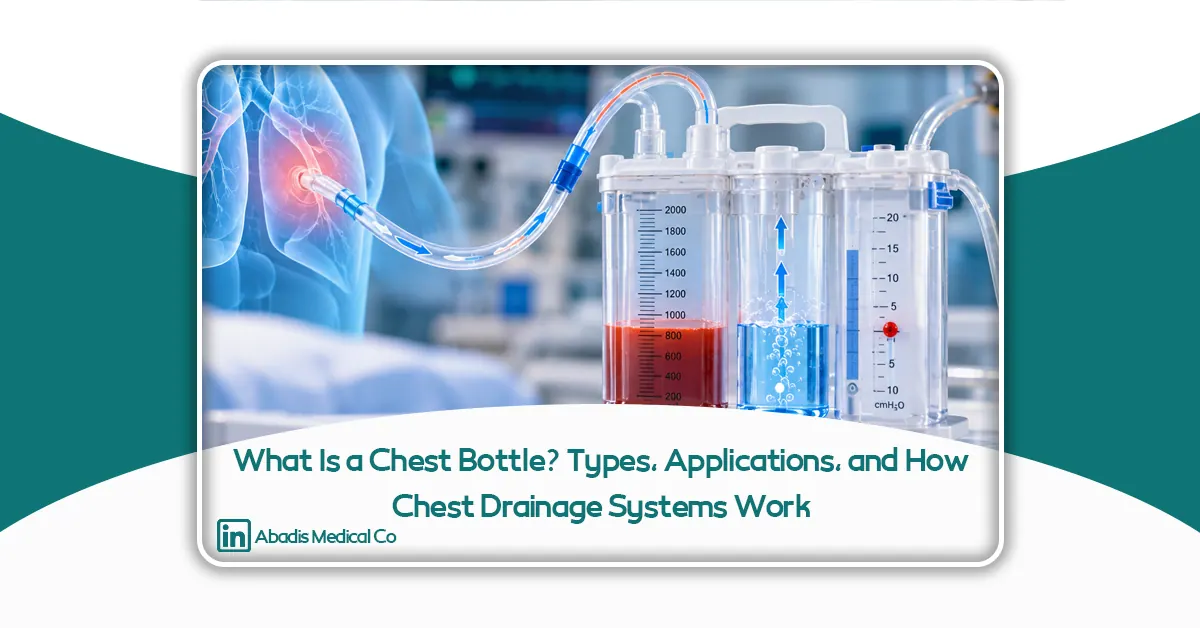
A chest bottle, also known as a chest drain bottle, is a component of a chest drainage system used to collect fluids removed from the pleural space and provide a controlled pathway for air to escape. It is typically connected to a chest tube and, depending on the system design, may use a water seal to prevent air from flowing back into the pleural cavity.
In conditions such as pneumothorax, hemothorax, pleural effusion, and following certain thoracic surgical procedures, an appropriate chest drainage system may be an essential part of patient treatment. However, selecting the system, determining whether suction is required, managing connections, and monitoring drainage output must be based on the patient’s clinical condition and the healthcare team’s instructions.
Drawing on guidance from the British Thoracic Society (BTS), educational resources from the National Center for Biotechnology Information (NCBI), and established clinical care principles, this article examines the structure and function of chest bottles, different drainage system configurations, their differences from conventional suction equipment, potential complications, and key purchasing considerations.
-
What Is a Chest Bottle?
A chest bottle, or chest drain bottle, is a collection chamber used in systems designed to remove air or fluid from the pleural space. In many healthcare settings, the term “chest bottle” is also used more broadly to refer to the external chest drainage unit.
To understand how this device works, it is important to understand the pleural space.
The lungs are covered by two layers of pleura. The visceral pleura covers the surface of the lungs, while the parietal pleura lines the inner surface of the chest wall. The narrow space between these layers contains a small amount of fluid that facilitates normal lung movement.
Under normal conditions, the pressure relationship between the pleural space and the surrounding environment helps keep the lungs expanded. When excessive air or fluid accumulates in this space, lung expansion may become restricted, potentially impairing respiratory function.
In such circumstances, a physician may insert a tube called a chest tube into the pleural space to remove air or fluid. This tube is connected to a drainage system that collects the drained material and, when equipped with an appropriate one-way mechanism, limits the return of air into the pleural cavity.
Therefore, a chest tube and a chest bottle are two different components of the same therapeutic system. The chest tube provides a drainage pathway from the body, while the chest bottle collects and helps manage the drainage output.

-
How Does a Chest Bottle Work?
The basic operating principle of many chest drainage systems is to provide a one-way pathway for air to escape while collecting drained fluids.
In water-seal systems, the air outlet pathway extends beneath the surface of water to a specified depth. This arrangement allows air leaving the pleural cavity to escape while preventing unrestricted backflow into the pleural space.
In simple terms, a water seal functions as a water-based one-way valve.
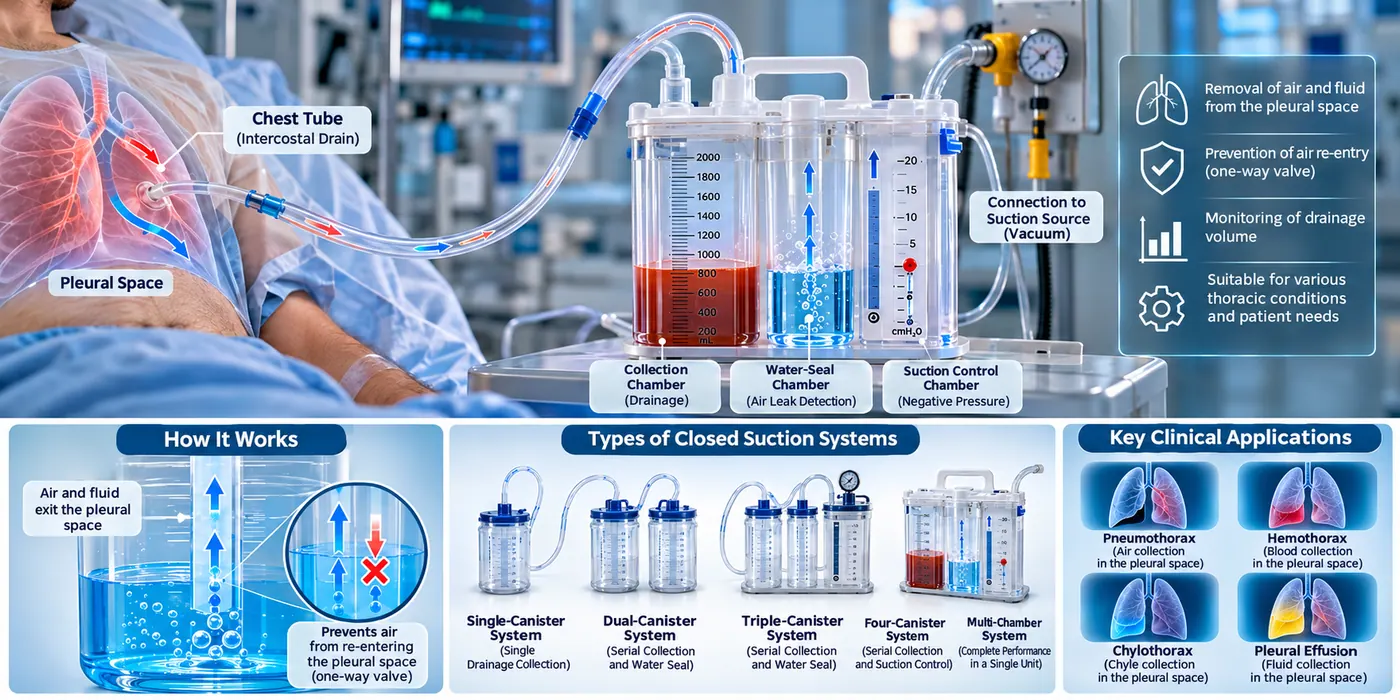
In multi-chamber drainage systems, fluid collection, water-seal operation, and suction control are separated into different compartments.
Consequently, many modern chest drainage devices combine functions that traditionally required several separate bottles into a single integrated unit.
General Operating Process
Air or fluid from the pleural space first passes through the chest tube into the drainage system.
Liquid collects in the collection chamber, while air travels through the designated outlet pathway.
In a water-seal system, the water seal prevents air from returning to the pleural space.
If suction has been prescribed, a dedicated chamber or suction regulator controls negative pressure according to the system’s design.
An important consideration is that not all patients with chest tubes require active suction.
In some clinical situations, drainage is performed through a water-seal system without an external vacuum source.
BTS guidance emphasizes that decisions regarding suction should be based on the patient’s clinical condition and the intended treatment objective.
-
Main Components of a Chest Drainage System
Although chest drainage systems vary in design, they generally include several essential components.
Fluid Collection Chamber
The collection chamber is designed to hold fluids drained from the pleural space.
Clear volume markings allow healthcare professionals to monitor and record drainage output over different time intervals.
Some models include more detailed measurement sections for smaller initial volumes and larger sections for continued drainage.
Water-Seal Chamber
The water-seal chamber controls airflow through a water-based one-way mechanism.
In certain systems, changes in water level may be visible during the patient’s respiratory cycle.
This movement, known as tidaling, can provide information about the drainage system, although its interpretation depends on the clinical situation and the device design.
Suction Control Chamber or Regulator
Chest drainage systems designed for connection to an external suction source include a mechanism for controlling suction pressure.
Depending on the system, suction control may be wet or dry.
Tubing and Connectors
Connecting tubes establish the pathway between the patient’s chest tube and the drainage system.
Connections must be secure and compatible with the manufacturer’s instructions to reduce the risk of air leakage or accidental disconnection.
Safety Indicators and Valves
Depending on the device model, additional features may include air-leak indicators, pressure-relief valves, or other safety mechanisms.
The availability and operation of these features must be confirmed through the product’s technical documentation.
-
Types of Chest Bottles and Chest Drainage Systems
Chest drainage systems can be classified according to the number of chambers, water-seal mechanism, and method of suction control.
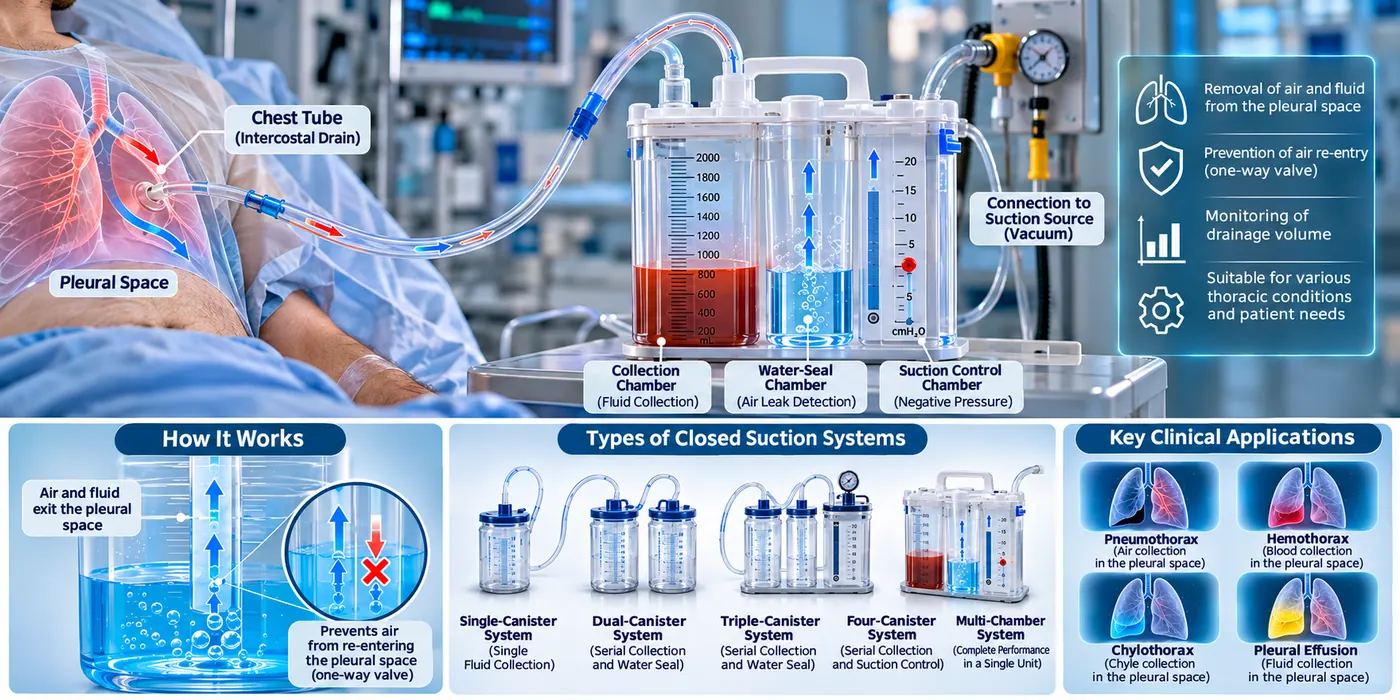
One-Bottle Chest Drainage System
In this traditional configuration, a single bottle serves both as a fluid collection chamber and a water seal.
The system has a relatively simple structure.
However, as the volume of collected fluid increases, the effective depth of the water seal may change, potentially affecting resistance to air drainage.
Understanding this limitation is important when evaluating traditional one-bottle systems.
Two-Bottle Chest Drainage System
In a two-bottle configuration, fluid collection and water-seal functions are separated into two bottles.
Separating the collection chamber from the water seal reduces the effect of increasing drainage volume on water-seal performance.
Three-Bottle Chest Drainage System
A traditional three-bottle system uses separate chambers for fluid collection, water sealing, and suction regulation.
This configuration provides the conceptual basis for many modern multi-chamber drainage devices.
Integrated and Disposable Chest Drainage Systems
Modern systems may combine the functions of multiple bottles into a single closed, integrated unit.
Depending on the product, these devices may include a graduated collection chamber, water seal, suction control mechanism, and air-leak indicator.
Potential practical advantages include fewer external connections and easier transport.
However, actual safety and performance depend on the specific product design and its evaluation.
Digital Chest Drainage Systems
Some advanced chest drainage systems incorporate electronic sensors and digital displays.
These systems may monitor parameters such as air-leak rate or drainage pressure.
Such information may support clinical decision-making and help document changes over time.
However, digital monitoring does not necessarily mean that a device uses artificial intelligence.
Comparison of Chest Drainage Systems
| System Type | Main Feature | Important Consideration |
| One-bottle | Fluid collection and water seal in one bottle | Increasing fluid volume may affect the effective water-seal depth |
| Two-bottle | Separate collection and water-seal chambers | Water-seal function is less affected by collected fluid volume |
| Three-bottle | Additional suction-control chamber | Allows suction regulation in traditional configurations |
| Integrated | Multiple functions in one unit | May reduce external connections |
| Digital | Electronic monitoring of drainage parameters | Requires appropriate training and device-specific instructions |
-
Clinical Applications of Chest Bottles
Chest drainage systems are used in various hospital departments, including emergency departments, thoracic surgery units, intensive care units, and inpatient wards.
However, the presence of pleural disease does not automatically mean that chest tube insertion is required.
Treatment decisions depend on symptom severity, imaging findings, the patient’s clinical condition, and applicable clinical guidelines.
Pneumothorax
Pneumothorax occurs when air accumulates in the pleural space, potentially causing partial or complete lung collapse.
In some patients, air removal through a chest tube and drainage system is necessary.
However, the 2023 BTS guideline also discusses conservative or ambulatory management for selected adults with primary spontaneous pneumothorax who have mild symptoms and are physiologically stable.
Therefore, the decision to use chest drainage must be individualized.
Hemothorax
Hemothorax refers to the accumulation of blood within the pleural space.
It may result from chest trauma or certain complications of medical procedures.
When drainage is indicated, a chest tube allows blood to be removed and helps clinicians assess ongoing bleeding.
Monitoring both the volume and rate of blood drainage is particularly important, as a sudden increase in bloody output may require urgent clinical evaluation.
Pleural Effusion
Pleural effusion is the abnormal accumulation of fluid in the pleural space.
It may be associated with heart disease, infection, malignancy, or other medical conditions.
Depending on the underlying cause, fluid volume, and patient condition, treatment options may include thoracentesis, chest tube drainage, or an indwelling pleural catheter.
Not every pleural effusion requires a chest bottle.
Pleural Empyema
Pleural empyema refers to the accumulation of pus within the pleural space and is generally associated with infection.
Treatment may include antibiotics and appropriate pleural drainage.
For the initial drainage of established pleural infection, BTS guidance conditionally recommends a small-bore chest tube, generally 14 French or smaller.
Nevertheless, the final choice of drainage approach depends on the patient’s clinical circumstances.
Postoperative Thoracic Care
Following certain lung, pleural, or thoracic surgical procedures, chest drainage systems may be used to remove postoperative air and fluid.
Monitoring drainage output can provide information about recovery and potential complications.
The type of system and duration of use are determined according to the surgical procedure and the surgeon’s instructions.
-
What Is the Difference Between a Chest Bottle and a Chest Tube?
One of the most frequently asked questions concerns the difference between these two terms.
A chest tube is a medical tube inserted by a physician to create a controlled drainage pathway between the pleural space and an external drainage system.
A chest bottle, on the other hand, is the external collection chamber or drainage unit that receives air and fluid through the chest tube.
| Feature | Chest Tube | Chest Bottle |
| Function | Provides a drainage pathway from the pleural space | Collects fluid and helps manage air drainage |
| Location | Partially inserted into the body | Located outside the patient’s body |
| Structure | Flexible medical tube | Bottle or integrated drainage unit |
| Main Application | Removal of pleural air or fluid | Collection and monitoring of drainage output |
These components must be compatible in terms of their connections and intended conditions of use.
-
Chest Bottle vs. Conventional Medical Suction Equipment
Although both chest drainage systems and conventional medical suction systems may be involved in fluid removal, their functions are not identical.
Conventional medical suction equipment is designed to remove secretions from different parts of the body or from the surgical field using negative pressure.
A chest drainage system, however, must accommodate the specific pressure conditions of the pleural space and, in many designs, prevent air from re-entering the pleural cavity.
The key difference is the controlled management of airflow and pressure within a pleural drainage system.
An external suction source without an appropriate water seal or other approved one-way mechanism and pressure-control system cannot safely replace a chest drainage unit.
Similarly, a disposable suction liner used for general surgical suction is not automatically suitable as a substitute for a chest bottle.
These products differ in design, intended use, and performance requirements.
This distinction is particularly important for healthcare facilities and medical equipment procurement professionals.
-
Does a Chest Bottle Always Require Suction?
No. A common misconception is that every chest drainage system must be connected to an active suction source.
In many clinical situations, air or fluid can drain through a water-seal system without external suction.
In other cases, a physician may prescribe controlled suction based on lung expansion, the presence of an air leak, or postoperative requirements.
BTS clinical guidance advises against the routine use of thoracic suction without a clear indication because evidence of benefit is insufficient across all patient groups.
The guidance also warns about the early application of suction after chest drain insertion due to the potential risk of re-expansion pulmonary oedema.
Therefore, suction pressure must be selected and controlled according to the physician’s instructions, the drainage system design, and the manufacturer’s instructions for use.
-
What Is a Water Seal and Why Is It Important?
The water seal is one of the most important components of traditional chest drainage systems.
Its purpose is to provide an outlet for air while preventing unrestricted airflow back into the pleural space.
In certain systems, the water-seal depth is set according to the manufacturer’s specifications.
For example, some commonly used drainage units have a designated water-seal level of 2 cm.
However, this value should not be applied to every chest drainage device without checking its specific instructions.
Water-Seal Tidaling
Tidaling refers to the movement of water within the water-seal chamber during the respiratory cycle.
This movement is influenced by changes in intrathoracic pressure.
Reduced or absent tidaling may have several explanations, including lung re-expansion or a problem within the drainage pathway.
It should therefore never be interpreted without considering the patient’s condition.
Bubbling in the Water-Seal Chamber
Bubbling in the water-seal chamber may indicate that air is passing through the system.
Intermittent bubbling can occur in some patients with an air leak.
Continuous bubbling or a sudden change in the bubbling pattern may require assessment of the connections, drainage system, and patient.
The significance of these findings depends on the device design and the patient’s clinical circumstances.
-
Potential Complications and Risks of Chest Drainage Systems
Like other medical interventions, chest drainage carries potential risks.
Some complications are associated with chest tube insertion, while others relate to the drainage system itself.
Air Leakage From Connections
Loose connections or damage to drainage tubing may allow air to enter the system or interfere with its performance.
Suspected air leakage must be evaluated in relation to the patient’s condition, bubbling pattern, and device characteristics.
Drainage Obstruction
Tubing kinks, blood clots, or other factors may restrict the passage of air or fluid.
A sudden cessation of drainage, particularly when accompanied by worsening respiratory status, requires prompt clinical assessment.
Infection
The chest tube insertion site and drainage connections may be associated with contamination risks if appropriate infection prevention practices are not followed.
Aseptic technique during relevant procedures, appropriate dressing care, and monitoring for signs of infection are important.
Re-expansion Pulmonary Oedema
Rapid or inappropriate evacuation of pleural air or fluid may, under certain circumstances, be associated with re-expansion pulmonary oedema.
For this reason, drainage management and the use of suction must remain under clinical supervision.
Accidental Disconnection
Pulling on the tubing or improper patient movement may result in disconnection of the drainage system or displacement of the chest tube.
Appropriate securing of the system and careful tubing management during patient movement can help reduce these risks.
-
Disposable vs. Reusable Chest Drainage Systems
The choice between disposable and reusable chest drainage systems should be based on product design, infection prevention requirements, operating costs, and the healthcare facility’s resources.
Disposable systems may reduce the need to clean and reprocess the collection unit, provided they are used according to their intended purpose and the manufacturer’s instructions.
Reusable systems, by contrast, require validated cleaning, disinfection, or sterilization procedures appropriate to their design and risk classification.
Economic evaluations should consider purchase price, consumables, labor, waste management, and other lifecycle costs.
Without reliable comparative data, it is not appropriate to claim that either option is universally superior in terms of cost, safety, or environmental impact.
For hospitals, the main priority is selecting a system that offers appropriate performance, acceptable technical documentation, and compatibility with clinical workflows.
-
How to Choose a Chest Bottle for Healthcare Facilities
Purchasing a chest bottle involves more than selecting a container with adequate capacity.
Hospital biomedical engineering departments and procurement committees should evaluate a combination of technical and clinical criteria.
Collection Capacity and Graduations
The collection capacity must be appropriate for the intended application, and drainage volume should be easy to read.
Type of Water-Seal Mechanism
It is important to determine whether the device uses a water seal, a dry one-way mechanism, or another technology, and how it must be prepared for use.
Suction Control
If the device is designed for use with suction, its pressure range and adjustment method must be clearly specified.
Connection Safety
Connections to the chest tube and other system components must comply with the manufacturer’s technical specifications.
Stability and Portability
The base or support design should help reduce the risk of tipping and accidental disconnection.
Product Documentation
Instructions for use, storage conditions, limitations, disposal procedures, and applicable regulatory documentation should be reviewed.
Staff Training
Even a well-designed medical device may be used incorrectly without adequate training.
Comparing products according to these criteria can help procurement teams make decisions based on more than purchase price alone.
-
The Role of Medical Device Design in Infection Prevention and Patient Safety
An important objective in the design of medical fluid collection equipment is to reduce unnecessary healthcare worker exposure to secretions while maintaining reliable device performance.
For chest drainage systems, connection quality, chamber stability, material strength, and the ability to monitor drainage output are important design considerations.
In addition, procedures for replacing, transporting, and disposing of used collection units may influence overall safety.
For medical device manufacturers, these considerations highlight the importance of research and development, appropriate material selection, and product performance evaluation.
Abadis Med operates in the field of medical equipment and consumables related to secretion management.
Studying technologies such as chest drainage systems can contribute to a better understanding of healthcare facility requirements and the importance of safe medical device design.
However, different fluid collection products must be clearly distinguished.
A chest bottle is a specialized system intended for pleural drainage and should not be replaced with a conventional suction canister or disposable suction liner unless the intended use and technical compatibility have been specifically established and approved.
- The Future of Chest Drainage Systems
Technological developments in chest drainage systems are increasingly focused on more precise monitoring, data recording, and portable equipment.
Some digital systems can measure and display air-leak information.
These capabilities may help healthcare professionals evaluate changes in a patient’s condition over time.
Portable drainage systems may also support greater mobility in selected patients, provided that appropriate patient selection, training, and follow-up are ensured.
In the future, analysis of drainage data may support research into clinical decision-support tools.
However, any new capability must be evaluated for measurement accuracy, safety, clinical effectiveness, and applicable regulatory requirements.
Conclusion
A chest bottle is an important component of a chest drainage system, designed to collect fluids and provide controlled air drainage from the pleural space.
It is used in clinical situations such as pneumothorax, hemothorax, certain pleural effusions, and postoperative thoracic care.
Understanding the differences between chest bottles, chest tubes, and conventional medical suction equipment is essential for appropriate device selection and safe clinical use.
Knowledge of water-seal operation and the potential risks associated with chest drainage systems is equally important.
The selection of a chest drainage system should be based on clinical requirements, technical specifications, component compatibility, and the manufacturer’s instructions.
Ultimately, reliable medical equipment and appropriate staff training work together to support patient safety and effective drainage management.
Scientific References
- British Thoracic Society. BTS Guideline for Pleural Disease. Thorax, 2023.
- Asciak R, et al. British Thoracic Society Clinical Statement on Pleural Procedures. Thorax, 2023.
- British Thoracic Society. Clinical Statement on Pleural Procedures, including appendices covering chest drain bottles and chest drainage devices.
- NCBI Bookshelf – StatPearls. Care of a Chest Tube.
- Open RN / NCBI Bookshelf. Nursing Advanced Skills, Chapter 6: Manage Chest Tube Drainage Systems.
- The Royal Children’s Hospital Melbourne. Nursing Guidelines: Chest Drain Management.
- Children’s Health Queensland. Chest Drain Insertion & Management – Nursing Skill Sheet.
Medical Disclaimer: This article is intended for scientific and educational purposes. Clinical decisions and chest drainage procedures must follow applicable medical guidelines, healthcare team instructions, and device-specific instructions for use.