

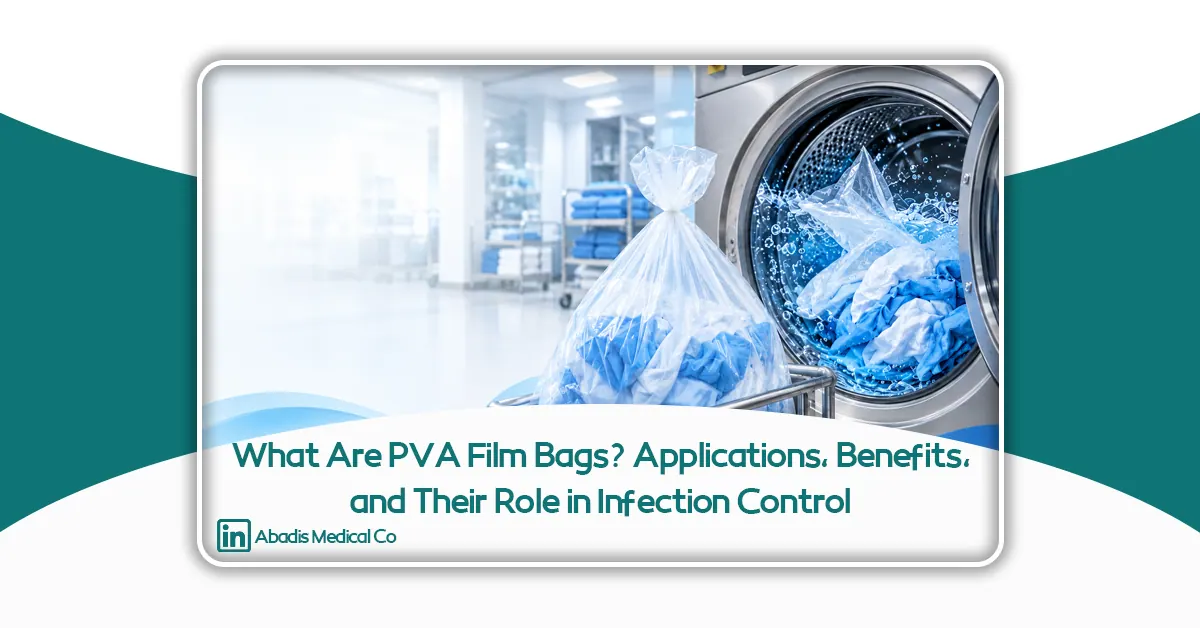
PVA Bags: An Innovation in Infectious Waste Management and Hospital Laundry
Introduction: Innovative Technology for Managing Contaminated Textiles
Managing contaminated clothing, bed linens, and other textiles in hospitals, healthcare facilities, and even certain home care environments requires solutions that minimize direct contact with potentially contaminated materials.
Water-soluble PVA bags are one innovative option for this purpose.
In suitable applications, these bags can be placed directly into a washing machine together with the laundry and dissolve under specified washing conditions.
Abadis Med is also exploring the potential of this technology through its research and development activities, particularly for applications related to infection control and textile management.
- What Are PVA Bags?
PVA stands for Polyvinyl Alcohol, a synthetic polymer available in various grades, some of which are water-soluble.
Bags manufactured from PVA film can exhibit different dissolution temperatures and mechanical properties depending on their formulation, thickness, and degree of hydrolysis.
Therefore, not all PVA bags are suitable for washing machines or for every washing temperature.
Product selection should always be based on the manufacturer’s technical specifications.
- Applications of PVA Bags in Hospitals and Laundry Facilities
In hospitals, contaminated bed linens, medical gowns, patient clothing, and other textiles should be collected and handled with minimal unnecessary manipulation.
PVA laundry bags can be filled and sealed at the point of collection and then transported to the laundry department inside an appropriate transport container.
If the bag is compatible with the facility’s laundry process, it may be placed directly into the washing machine without manually emptying its contents.
This approach may reduce opportunities for direct contact with contaminated textiles when opening laundry bags.
However, PVA laundry bags do not replace personal protective equipment (PPE), proper segregation procedures, or validated disinfection processes.
They should be considered one component of a broader infection prevention and laundry management strategy.
- How to Use PVA Bags in Washing Machines
First, contaminated textiles are collected in an appropriate PVA laundry bag according to the healthcare facility’s established procedures.
The bag is then securely closed without exceeding its recommended filling capacity and transported in a suitable trolley or container.
At the laundry facility, staff must verify the bag’s dissolution temperature, washing machine type, washing program, and compatibility with detergents.
Once compatibility has been confirmed, the sealed bag can be placed in the washing machine together with the contaminated textiles.
The PVA film dissolves during the appropriate stage of the washing cycle, while the textiles undergo the facility’s standard washing and disinfection process.
It is important to emphasize that dissolving the PVA film does not, by itself, disinfect the laundry.
Effective disinfection depends on the validated washing process and its operating conditions.
- Potential Benefits of PVA Bags in Healthcare Facilities
When properly selected and used, PVA laundry bags may offer several operational advantages:
- Reducing the need to manually open bags containing contaminated laundry
- Limiting certain opportunities for direct contact with contaminated textiles
- Simplifying selected laundry handling procedures
- Supporting standardized collection and transport practices
- Potentially reducing the use of certain conventional plastic laundry bags
However, actual cost savings, reductions in occupational exposure, and environmental benefits must be evaluated for each healthcare facility and specific product.
These outcomes should not be assumed without appropriate operational data.

- Applications of PVA Bags in Everyday Life
Water-soluble film technology is not limited to hospitals.
In home environments, certain PVA bags specifically designed for laundry applications may be used to collect and transfer heavily contaminated clothing or textiles directly into a washing machine.
For example, this approach may be useful in certain home care situations involving patients, provided that appropriate hygiene procedures are followed and the bag is compatible with the washing machine.
However, this does not mean that every PVA bag is suitable for domestic laundry applications.
The product’s intended use and technical instructions must always be considered.
- Other Everyday Applications of Water-Soluble PVA Films
PVA films are also used in the packaging of pre-measured doses of certain laundry and dishwasher detergents.
In these products, the water-soluble film dissolves upon contact with water, releasing the detergent inside.
Water-soluble films may also be used in certain single-dose packaging applications and light industrial products.
These products must be stored out of children’s reach and should not be confused with ordinary household waste bags.
Their suitability depends on the intended application and the characteristics of the specific film formulation.
- Can PVA Bags Replace Conventional Household Garbage Bags?
PVA bags are not suitable for all types of everyday household waste.
Wet waste, liquids, and environmental humidity may weaken the film or cause premature dissolution, depending on the PVA formulation.
Furthermore, PVA bags designed for laundry applications are not intended for sharp objects, hazardous chemicals, or infectious waste requiring specialized disposal.
For this reason, the appropriate application must be determined according to the type of bag and the manufacturer’s instructions.
The term “PVA garbage bag” should not create the impression that these products can universally replace conventional household waste bags.
- PVA and the Environment: Understanding the Difference Between Water Solubility and Biodegradability
One of the most important considerations regarding PVA technology is the distinction between water solubility and biodegradability.
When PVA dissolves in water, the polymer does not simply disappear from the environment.
Instead, the dissolved polymer enters the water or wastewater system.
Under certain conditions, and in the presence of suitable microorganisms, PVA can undergo biodegradation.
However, the extent and rate of biodegradation depend on the polymer’s structure and the conditions of the wastewater treatment process.
Therefore, claims such as “completely environmentally friendly” or “leaves no residue” are not scientifically justified without reliable testing and supporting evidence.
A comprehensive environmental comparison between PVA and conventional plastics should consider:
- Life cycle assessment (LCA)
- Raw material consumption
- Transportation requirements
- Energy consumption during washing
- The fate of dissolved PVA in wastewater treatment facilities
- The environmental impacts of the alternative materials being compared
These factors are necessary for evaluating the actual environmental performance of water-soluble PVA products.

- Technical Challenges and Safety Considerations
Selecting an appropriate PVA bag requires consideration of several technical and operational factors.
These include:
- Resistance to humidity during storage
- Load-bearing capacity when containing wet textiles
- Quality and strength of bag seams
- Dissolution temperature
- Compatibility with detergents and washing equipment
- Wastewater management requirements
Healthcare workers and other users should receive appropriate instructions and avoid unnecessary contact with contaminated contents.
For medical and healthcare applications, compliance with relevant regulations and infection prevention procedures must remain a priority.
- Innovation and Research and Development at Abadis Med
With its experience in the medical device and healthcare consumables industry, Abadis Med continues to explore emerging technologies related to infection prevention and control through its research and development activities.
Evaluating PVA bags for the transportation and washing of contaminated textiles may involve several areas of investigation, including:
- Studying PVA film formulations
- Testing mechanical strength and durability
- Determining dissolution temperatures
- Evaluating compatibility with hospital laundry processes
- Assessing potential environmental impacts
These research activities may help determine whether water-soluble PVA technology can meet the practical requirements of healthcare facilities.
However, discussing this research direction does not imply that Abadis Med has already begun mass production or confirmed the commercial availability of PVA bags.
Conclusion
When appropriately designed and selected, PVA bags can provide a practical option for certain processes involving the washing of contaminated textiles.
Water-soluble film technology also has applications in everyday products, including pre-measured detergent packaging.
Nevertheless, responsible adoption of this technology requires an understanding of its limitations, appropriate safety practices, and scientific evaluation of environmental impacts.
Through research and development, Abadis Med can explore the feasibility of applying this technology to the real operational needs of healthcare facilities.
Scientific References
- Centers for Disease Control and Prevention (CDC). Guidelines for Environmental Infection Control in Health-Care Facilities: Laundry and Bedding.
https://www.cdc.gov/infection-control/hcp/environmental-control/laundry-bedding.html
United States Environmental Protection Agency (EPA). Safer Choice: Helping Consumers and Businesses Find Safer Products.
https://www.epa.gov/saferchoice