

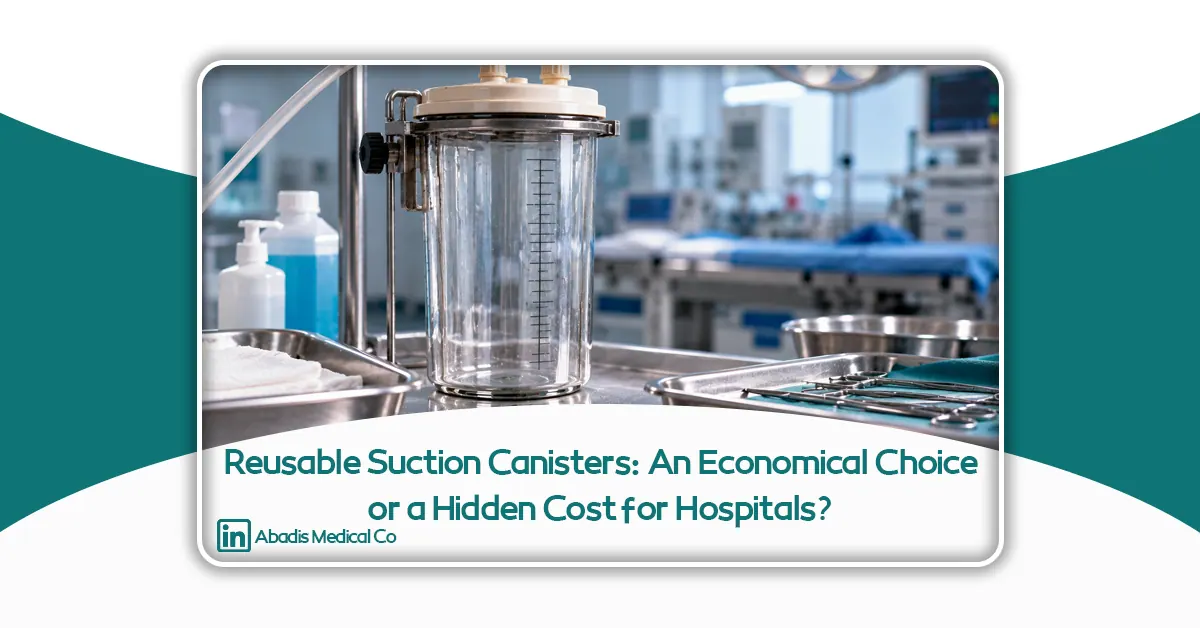
The Hidden Costs of Reusable Suction Canisters in Hospitals: From Water Consumption to Infection Control
Introduction: Are Reusable Suction Canisters Really Cost-Effective?
Cost control is one of the most important factors in maintaining sustainable healthcare services. Rising medical equipment prices, limited financial resources, maintenance expenses, and the need to comply with infection prevention standards have encouraged hospital administrators to evaluate the economic implications of both disposable and reusable medical equipment.
One device commonly used across hospital departments is the medical suction canister. Its primary function is to collect blood, secretions, and other bodily fluids during suction procedures.
Traditional suction systems use reusable suction canisters. After each use, these containers must be emptied, cleaned, disinfected, and prepared for reuse according to the manufacturer’s instructions and hospital protocols.
At first glance, reusable canisters may appear more economical because hospitals do not need to purchase a new container for every patient.
However, is the initial purchase price the only relevant factor in determining cost-effectiveness?
In practice, reusable suction canisters can involve a range of direct and indirect expenses. These costs are often recorded separately across different hospital departments and may therefore be overlooked when evaluating the overall economics of suction systems.
They include water consumption, cleaning and disinfecting chemicals, staff time, equipment depreciation, waste management, and measures required to minimize exposure to contaminated fluids.
In this article, Abadis Med examines the hidden costs associated with reusable suction canisters and explains how a total cost of ownership analysis can support more informed decisions about medical fluid collection systems.
-
What Is a Reusable Suction Canister?
A reusable suction canister is a collection container used in medical suction systems to collect bodily fluids and secretions.
These canisters are generally manufactured from durable materials and, when approved by the manufacturer, may be reused after appropriate reprocessing.
Medical suction canisters are used in various healthcare settings, including operating rooms, emergency departments, intensive care units, inpatient wards, and specialized clinics.
In traditional systems, patient secretions are collected directly inside the canister.
Once the procedure is completed or the fluid reaches the permitted fill level, the canister is removed from service and prepared for subsequent use.
Depending on the product design and manufacturer’s instructions, reprocessing may involve:
- Emptying the contents
- Washing and cleaning
- Disinfection
- Rinsing
- Drying
- Inspecting the container for damage
Each stage requires resources, which means that the actual cost of using a reusable suction canister extends beyond its initial purchase price.
-
The Hidden Cost of Water Consumption
Water consumption is one of the first expenses that should be considered when evaluating reusable suction canisters.
In systems where patient secretions come into direct contact with the collection container, proper cleaning after use is part of the reprocessing procedure.
The amount of water required depends on factors such as canister capacity, contamination type, cleaning method, available equipment, and hospital protocols.
An Illustrative Calculation
Consider a healthcare facility that performs 100 suction canister cleaning cycles per day.
If each cleaning cycle consumes an average of 10 liters of water:
| Measurement | Water Consumption |
| Cleaning cycles per day | 100 |
| Water per cycle | 10 liters |
| Daily water consumption | 1,000 liters |
| Annual water consumption | 365,000 liters |
These figures represent a hypothetical scenario rather than measured data from a particular hospital.
To determine the actual water savings associated with changing a suction collection system, a hospital should measure water consumption before and after implementation.
This approach provides a more reliable basis for evaluating both economic and environmental benefits.
-
The Cost of Cleaning Agents and Disinfectants
Suction canisters used in healthcare facilities may come into contact with blood, respiratory secretions, and other bodily fluids.
Their reprocessing must therefore follow the manufacturer’s instructions, risk assessment requirements, and hospital infection prevention protocols.
This process may require cleaning agents and disinfectants.
However, the total expense is not limited to purchasing these chemicals.
Additional considerations include solution preparation, concentration monitoring, required contact times, personal protective equipment, and safe chemical handling.
Improper use of cleaning chemicals may also create occupational health risks.
Hospitals must therefore consider both chemical costs and their compatibility with medical equipment.
How Disposable Suction Liners Differ
Disposable suction liner systems are designed to prevent collected secretions from coming into direct contact with the reusable outer canister.
When used correctly and when the system remains intact, this design may reduce the need to wash the outer canister directly after every procedure.
Nevertheless, external surfaces, connectors, and reusable canister components must still be cleaned or disinfected according to the manufacturer’s instructions and the healthcare facility’s infection prevention policies.

-
Labor Costs: The Expense Missing From Equipment Invoices
One of the most significant hidden costs of reusable suction canisters is the staff time required for reprocessing.
After each use, personnel may need to transport the canister, safely empty its contents, disassemble components, and complete the required cleaning and disinfection procedures.
These activities consume working hours that could otherwise be allocated to other hospital operations.
An Illustrative Labor Calculation
Suppose reprocessing one suction canister requires 15 minutes and a hospital processes 80 canisters daily.
| Measurement | Labor Requirement |
| Reprocessing time per canister | 15 minutes |
| Canisters processed daily | 80 |
| Total daily labor | 1,200 minutes |
| Daily working hours | 20 hours |
| Annual working hours | 7,300 hours |
The annual calculation assumes a consistent workload throughout all 365 days of the year.
This example does not necessarily mean that the hospital must employ additional personnel.
Rather, it demonstrates how much working time may be devoted to reprocessing activities.
A comprehensive economic assessment should consider actual labor costs and whether time saved could be allocated to other productive tasks.
-
Depreciation, Maintenance, and Replacement Costs
Although reusable suction canisters are designed for repeated use, they do not have an unlimited service life.
Repeated handling, exposure to chemicals, transportation, accidental impacts, and cleaning procedures can gradually affect their condition.
Depending on the product design, potential problems may include:
- Damage to the canister body
- Reduced transparency
- Worn seals or gaskets
- Damaged lids
- Defective connectors
Any deterioration that affects performance may require inspection, repair, or replacement.
Hospitals must also maintain an adequate number of canisters to ensure continuity of care while some containers are being reprocessed or temporarily removed from service.
Consequently, the total ownership cost of reusable suction canisters may include the initial purchase, spare parts, reserve inventory, periodic inspections, and replacement of worn components.
These expenses should be calculated annually and considered in relation to the number of uses.
-
Infection Prevention and Occupational Exposure Costs
Infection prevention in hospitals involves much more than choosing a particular medical product.
It includes equipment design, operating procedures, environmental cleaning, personal protection, and waste management.
In traditional suction systems, emptying and washing contaminated canisters may create opportunities for healthcare workers to come into contact with biological fluids, particularly when safe handling procedures are not followed correctly.
Potential hazards include fluid splashes, surface contamination, and unintended contact with collected secretions.
These risks should be included in the facility’s occupational safety assessment.
The Role of Closed Collection Systems
Closed secretion collection systems are designed to minimize unnecessary direct contact with contaminated contents.
Disposable suction liners can support this approach by collecting fluids inside a dedicated single-use liner.
When used correctly, they may reduce the need to empty and directly wash the reusable outer canister.
However, it would be inaccurate to claim that disposable suction liners alone eliminate hospital-acquired infections or definitively reduce infection rates.
Such claims would require appropriate clinical studies and reliable comparative evidence.
From a risk management perspective, the primary potential value of disposable suction liner systems is the reduction of certain direct fluid-handling steps and the simplification of collection and disposal procedures.
-
Medical Waste and Contaminated Wastewater Management
Another important consideration in the use of reusable suction canisters is the management of collected fluids and wastewater generated during cleaning.
Fluids collected through medical suction may contain biological contaminants.
Their disposal must comply with local regulations, hospital policies, and the characteristics of the collected material.
In reusable systems, cleaning generates wastewater in addition to the original collected fluids.
This can have implications for water consumption, wastewater management, and infection prevention procedures.
How Disposable Systems Change Waste Generation
Disposable suction liner systems change the waste profile.
Instead of repeatedly washing the collection container, the used liner becomes medical waste and must be disposed of according to applicable healthcare waste management requirements.
Therefore, an environmental comparison between reusable canisters and disposable suction liners should not focus exclusively on water savings.
A comprehensive assessment should also consider:
- Raw material consumption
- Waste volume and weight
- Transportation
- Final disposal methods
- Water and energy consumption
- Equipment service life
Only by evaluating these factors together can hospitals develop a more complete understanding of the environmental implications of each system.
-
Equipment Downtime and Canister Availability
In certain clinical departments, immediate access to a functioning suction system is essential.
If reusable canisters require reprocessing after use, hospitals must maintain a sufficient inventory of ready-to-use containers.
Shortages of clean canisters, damaged components, or delays in cleaning may interfere with equipment preparation.
The extent of this disruption depends on hospital size, the number of available canisters, clinical workload, and equipment management practices.
With disposable suction liner systems, replacing the liner may simplify preparation for the next procedure, provided that the reusable outer canister is ready and sufficient compatible liners are available.
However, these systems also require appropriate inventory management, staff training, and component compatibility.

-
How to Calculate the True Cost of a Suction Canister
A more accurate economic assessment can be performed using the concept of Total Cost of Ownership (TCO).
Rather than focusing only on the purchase price, TCO considers all expenses associated with acquiring, operating, maintaining, and disposing of equipment throughout its lifecycle.
Total Cost of Ownership for Reusable Suction Canisters
The annual cost may include:
- Amortized initial purchase cost
- Water consumption
- Cleaning and disinfecting chemicals
- Labor costs
- Maintenance and replacement expenses
- Waste and wastewater disposal costs
Total Cost of Ownership for Disposable Suction Liner Systems
The annual cost may include:
- Amortized cost of the reusable outer canister
- Disposable liner purchases
- Labor required for liner replacement
- Cleaning of reusable components
- Medical waste disposal costs
Cost per Use
A practical comparison can be made using the following formula:
Average Cost per Use = Total Annual System Cost ÷ Number of Uses per Year
This calculation allows hospitals to compare the two systems using their actual operational data.
Neither approach can be considered universally more economical without evaluating the specific conditions of each healthcare facility.
-
The Role of Abadis Disposable Suction Liners in Optimizing Hospital Processes
Abadis Med, a knowledge-based medical device manufacturer, specializes in medical consumables and secretion management solutions.
Disposable suction liners are among the company’s core products.
The Abadis suction liner system is designed to collect secretions inside a disposable liner while reducing direct contact between the collected fluids and the reusable outer canister.
Key characteristics of this system include:
- A disposable liner placed inside a compatible outer canister
- The ability to replace the liner after use
- Protective components appropriate to the product design
This configuration may help optimize secretion collection procedures, reduce certain canister reprocessing activities, and simplify equipment management.
However, the actual economic savings achieved by a hospital must be calculated using that facility’s own operational data.
For hospitals performing large numbers of surgical procedures or using suction systems extensively, a comparative cost study may support more informed purchasing decisions.
Such an evaluation is best conducted collaboratively by biomedical engineering, infection prevention, environmental services, finance, and procurement departments.
-
Which Hospitals Should Evaluate Suction Canister Costs?
Analyzing the hidden costs of reusable suction canisters can be useful for any healthcare facility.
However, it may be particularly valuable for:
- Hospitals with high operating room activity
- Specialized surgical centers
- Large hospitals with intensive care departments
- Facilities facing water resource limitations
- Hospitals experiencing staffing constraints
- Healthcare organizations reviewing infection prevention policies
- Facilities seeking to reduce resource consumption or modernize medical equipment
In these settings, selecting a suction collection system is more than a purchasing decision.
It is part of broader hospital operational management.
-
Reusable Suction Canisters vs. Disposable Suction Liners: Cost Comparison
| Evaluation Criteria | Reusable Suction Canister | Disposable Suction Liner System |
| Initial investment | Purchase of reusable canister | Purchase of outer canister and disposable liners |
| Consumable cost per use | Cleaning and reprocessing resources | Single-use liner |
| Direct canister washing | Generally required after use | Usually reduced when used correctly |
| Labor requirements | Emptying and reprocessing | Liner replacement and safe disposal |
| Waste management | Collected fluids and reprocessing wastewater | Collected fluids and used liner |
| Overall cost | Depends on reuse frequency and reprocessing expenses | Depends on liner price and disposal expenses |
Important: The final economic outcome depends on purchase prices, utilization rates, water costs, staff wages, and waste disposal methods.
Conclusion: Better Economic Decisions Begin With Understanding Hidden Costs
Selecting an appropriate hospital suction system should not be based solely on equipment purchase prices.
Reusable suction canisters offer the advantage of repeated use but require defined procedures for emptying, cleaning, disinfection, and preparation.
These activities may generate expenses related to water consumption, chemicals, staff time, and equipment maintenance.
Disposable suction liner systems, on the other hand, change the way secretions are collected and may reduce some of these activities.
However, liner purchasing costs, inventory management, and medical waste disposal must also be included in the economic assessment.
Therefore, the most cost-effective solution is the system that delivers a more favorable total cost under the hospital’s actual operating conditions while meeting patient safety, occupational safety, and infection prevention requirements.
Through its disposable suction liner products, Abadis Med provides healthcare facilities with a solution for medical secretion collection and management.
A technical and economic comparison between this system and traditional reusable canisters can help hospitals make evidence-informed decisions aligned with their operational requirements.
Scientific References
- Centers for Disease Control and Prevention (CDC). Guideline for Disinfection and Sterilization in Healthcare Facilities.
https://www.cdc.gov/infection-control/hcp/disinfection-sterilization/index.html - World Health Organization (WHO). Health-care Waste.
https://www.who.int/news-room/fact-sheets/detail/health-care-waste - Centers for Disease Control and Prevention (CDC). Core Infection Prevention and Control Practices.
https://www.cdc.gov/infection-control/hcp/core-practices/index.html - International Organization for Standardization (ISO). ISO 14971 — Medical Devices: Application of Risk Management to Medical Devices.
https://www.iso.org/standard/72704.html - International Organization for Standardization (ISO). ISO 13485 — Medical Devices: Quality Management Systems.
https://www.iso.org/standard/59752.html