

Abstract
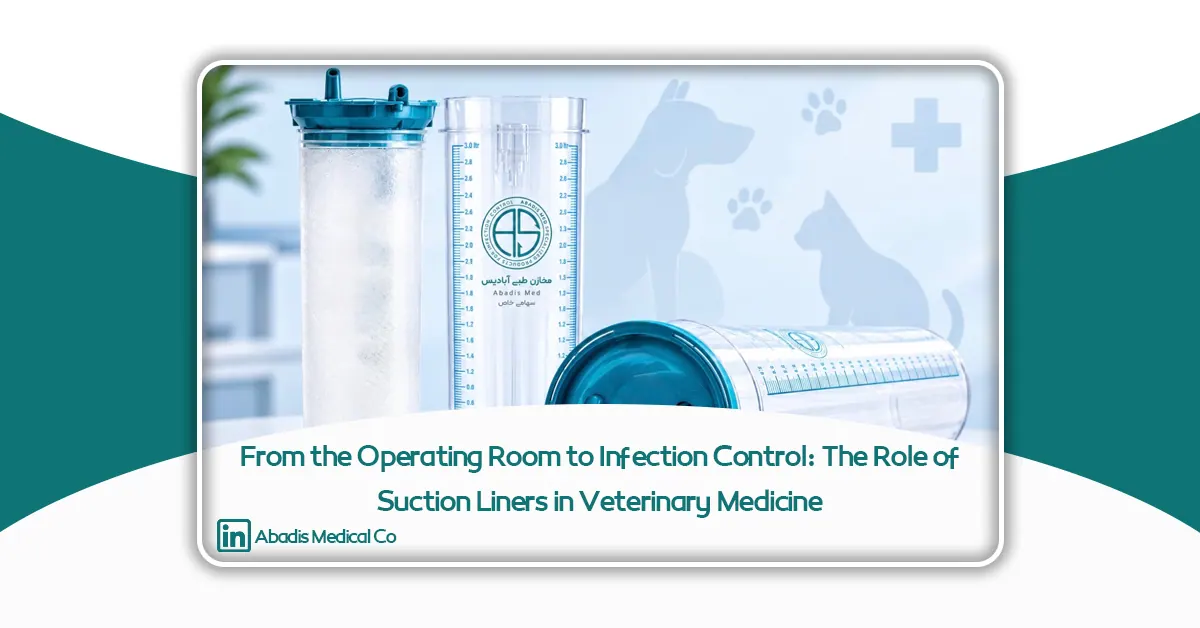
The safe management of blood, secretions, and fluids generated during veterinary procedures and surgeries is an essential requirement for veterinary clinics and hospitals. Suction systems use negative pressure to remove fluids from treatment areas and transfer them into collection containers. As part of these systems, disposable suction liners can simplify fluid management and, when used correctly, reduce direct contact between healthcare personnel and collected fluids.
This article examines the structure and operation of disposable veterinary suction liners, their applications in animal surgery, differences from reusable suction canisters, the role of protective filters, infection control considerations, and criteria for selecting suitable products. It also discusses the role of Abadis Med products in providing consumables for compatible suction systems.
Introduction: The Importance of Fluid and Secretion Management in Veterinary Facilities
Modern veterinary clinics provide a wide range of services, from routine examinations and outpatient treatments to complex surgeries, emergency procedures, and intensive care for animals. In many of these procedures, collecting blood, saliva, secretions, and irrigation fluids is an essential part of treatment.
The accumulation of these fluids in the surgical field may obstruct the veterinarian’s visibility, make precise procedures more difficult, and complicate the management of the treatment environment. Therefore, suction equipment and its accessories are important components of veterinary operating rooms and treatment departments.
However, proper suction performance does not depend solely on vacuum pump power. The quality of connecting tubes, collection canisters, connectors, protective components, and fluid disposal procedures also plays an important role.
One solution used in compatible suction systems is the disposable suction liner, which is placed inside a rigid collection canister to collect aspirated fluids.
The importance of these devices becomes even greater in veterinary environments, where infection control challenges are associated not only with routine clinical risks but also with the diversity of animal species and potential exposure to zoonotic pathogens.
The American Animal Hospital Association (AAHA) guidelines emphasize that equipment and environmental surfaces can contribute to pathogen transmission. Therefore, structured cleaning, disinfection, and infection prevention programs are essential in veterinary facilities.
What Is a Veterinary Suction Liner?
A veterinary suction liner is a flexible, disposable collection bag designed to collect fluids within compatible suction systems. It is generally placed inside a rigid canister or dedicated holder and, through suitable lids and connectors, forms part of the fluid transfer pathway.
During operation, the suction device generates negative pressure, drawing fluids from the treatment area through a suction tip and connecting tube into the collection liner.
After the procedure, the used liner is removed according to the manufacturer’s instructions and disposed of in compliance with applicable healthcare waste management regulations.
The main difference between this method and direct collection into reusable canisters is that fluids are contained within the disposable liner. In a properly designed system, this can reduce the need for direct emptying of the canister and certain internal cleaning procedures.
However, a disposable suction liner is not a standalone suction device. It requires a compatible vacuum source, collection canister, and suitable connections to function properly.
Components of a Disposable Suction Liner System
Understanding the operation of veterinary suction liners requires familiarity with the main components of the fluid collection system.
1. Fluid Collection Liner
The liner is the primary component responsible for collecting and containing aspirated fluids. Its material, mechanical strength, capacity, and connector quality should be suitable for the intended application.
Resistance to negative pressure and anticipated fluids is an important technical consideration. Leakage or damage to the liner may compromise the performance of the suction system.
2. Rigid Collection Canister
The rigid canister provides structural support for the disposable liner. Its design must match the liner’s shape, dimensions, and capacity.
In systems equipped with internal disposable liners, the supporting canister does not necessarily come into direct contact with collected secretions. Nevertheless, it must still be inspected and cleaned according to the manufacturer’s instructions.
3. Lid and Connectors
The lid defines the connection pathways within the suction system. In many designs, the patient connection and vacuum connection are separate.
Correct connection of the patient tubing and negative-pressure pathway is essential because incorrect connections may reduce suction efficiency or interfere with system performance.
4. Protective Filter
Some suction liner systems incorporate a hydrophobic filter or another overflow protection mechanism.
Depending on their design and technical specifications, these components can help prevent fluids from entering the vacuum pathway. Their protective performance should be evaluated using valid product-specific test results and technical documentation.
How Do Disposable Suction Liners Work in Veterinary Medicine?
The operation of a disposable suction liner is based on the pressure difference between the suction site and the fluid collection system.
When the suction equipment is activated, the vacuum pump generates the required negative pressure. This pressure difference causes air and fluids to move along the designated pathway.
Fluids travel through the suction tip and connecting tubing into the collection liner. In an appropriately designed system, the vacuum pathway is separated from the fluid inlet, and protective components are incorporated to reduce the possibility of fluids reaching the vacuum source.
Suction performance depends on several factors, including the negative pressure generated by the equipment, airflow rate, tubing diameter and length, suction tip design, connector integrity, and the liner’s filling level.
Applications of Disposable Suction Liners in Veterinary Facilities
Use in Small Animal Surgery
One of the main applications of disposable veterinary suction liners is the collection of blood and fluids during surgical procedures involving dogs, cats, and other companion animals.
During abdominal surgery, orthopedic procedures, mass removal, and certain reconstructive operations, removing excess fluids can help maintain a clear surgical field.
In these circumstances, the suction liner collects fluids transferred by the suction equipment and should be selected according to the expected fluid volume.
Applications in Veterinary Emergency Departments
In certain emergency situations, immediate access to suction equipment is essential for managing fluids and secretions.
Using a ready-to-use, compatible collection system may help organize consumable supplies and reduce some of the preparation steps required after each procedure.
However, the availability of a disposable liner does not eliminate the need to check suction equipment functionality and maintain emergency equipment readiness.
Use in Veterinary Dentistry
Collecting saliva, blood, and irrigation fluids is important during veterinary dental procedures.
When the suction equipment and collection system are suitable for this application, disposable suction liners may form part of the fluid management process.
Specialized dental suction equipment may have different technical requirements and configurations. Therefore, compatibility must be assessed separately.
Applications in Veterinary Hospitals and Specialized Centers
In facilities where multiple procedures are performed daily, managing consumable equipment and operating room preparation time becomes increasingly important.
Disposable suction liner systems may help reduce certain canister emptying and cleaning procedures, provided that the system design and instructions for use support these benefits.
Applications in Large Animal Veterinary Care
Veterinary facilities treating horses, livestock, and other large animals may also require fluid collection systems during certain surgical and therapeutic procedures.
In these situations, fluid volume, environmental conditions, equipment portability, and collection capacity are particularly important.
The appropriate collection capacity should be selected according to the type of procedure and a realistic assessment of the expected fluid volume.
The Role of Disposable Suction Liners in Veterinary Infection Control
Infection control is a fundamental aspect of safety management in veterinary clinics and hospitals. Animals receiving treatment may carry various microorganisms, while exposure to blood, secretions, tissues, and contaminated surfaces can increase the risk of contact with infectious agents among personnel and other patients.
A study published in the American Journal of Veterinary Research in 2000 investigated bacterial contamination of suction tips used during surgical procedures in dogs and cats.
Bacterial contamination was identified in suction tips during 30 of 44 surgical procedures, representing approximately 68% of the cases examined.
These findings demonstrate that suction-related equipment may become contaminated during surgery, highlighting the importance of aseptic practices and appropriate hygienic management.
However, this study did not specifically investigate disposable suction liners and does not establish that their use directly reduces infection rates.
In compatible collection systems, disposable suction liners may offer several potential benefits:
- Reducing the need to empty fluids directly from reusable canisters.
- Limiting certain opportunities for personnel to come into contact with secretions.
- Reducing the possibility of splashing during emptying when an appropriate closed collection system is used.
- Simplifying certain aspects of liquid waste management.
- Reducing some procedures involving contact with internal canister surfaces.
Despite these potential advantages, disposable suction liners alone do not guarantee infection prevention. Proper hand hygiene, personal protective equipment, surface disinfection, and appropriate waste management remain essential.
The Importance of Hydrophobic Filters in Veterinary Suction Liners
One important consideration in suction system design is protecting the vacuum source against fluid entry.
If secretions enter the vacuum pathway, they may interfere with equipment performance and contaminate internal components.
A hydrophobic filter is made from water-repellent materials. When appropriately designed, it can allow air to pass through while resisting liquid penetration.
In certain systems, the filter or protective mechanism blocks the suction pathway when fluids reach a specified level, thereby reducing the risk of overflow.
The international standard ISO 10079-4:2021 describes general requirements for medical suction equipment and addresses aspects such as vacuum source protection and overflow prevention devices.
Nevertheless, several technical considerations should be taken into account.
Not all hydrophobic filters provide identical performance. Resistance to liquid penetration is also different from microbial filtration efficiency.
Furthermore, the presence of a protective filter does not justify filling the liner beyond its permitted capacity.
When selecting a product, users should review the filter’s technical specifications, operating limitations, and the manufacturer’s instructions.
Disposable Suction Liners vs. Reusable Suction Canisters
One of the important decisions for veterinary facility managers is choosing between reusable collection canisters and suction systems equipped with disposable liners.
Both methods can be used to collect secretions, but they differ in emptying procedures, cleaning requirements, operating costs, and waste management.
| Comparison Criteria | Reusable Suction Canister | Disposable Suction Liner |
|---|---|---|
| Fluid collection | Directly inside the canister | Inside a liner placed within the canister |
| Procedure after use | Emptying, cleaning, and reprocessing | Liner removal and disposal according to instructions |
| Direct contact with secretions | May occur during emptying | Can be reduced in a suitable closed system |
| Cleaning requirements | Internal canister cleaning is necessary | Reusable components still require cleaning |
| Operating costs | Cleaning agents, labor, and reprocessing | Liner purchase and disposal |
| Waste management | Includes fluid emptying and disposal | Includes management of the liner and its contents |
| Equipment compatibility | Depends on the device and canister | Depends on the liner, canister, lid, and connectors |
This comparison highlights the importance of selecting a solution based on the actual operating conditions of the veterinary facility.
For example, a veterinary hospital performing a high number of surgical procedures may have different collection capacity and workflow requirements compared with a small clinic.
Disposable liners may also increase the amount of solid waste generated. Therefore, their environmental impact should be assessed by considering water consumption, chemical use, energy requirements, and waste generation together.
The Impact of Disposable Suction Liners on Water and Disinfectant Consumption
In conventional systems where secretions are collected directly inside reusable canisters, the canisters generally require cleaning and reprocessing after fluid disposal, according to the manufacturer’s instructions.
This process may require water, detergents, disinfectants, and staff time.
In contrast, disposable suction liners used in appropriate systems can reduce the need for direct cleaning of the canister’s internal surfaces because collected fluids remain inside the liner.
However, actual savings depend on several factors, including frequency of use, canister type, cleaning methods, water consumption, and facility-specific procedures.
For a reliable evaluation, veterinary facilities can measure and compare water consumption, cleaning time, and detergent usage associated with the two systems.
Therefore, reduced consumption of water and disinfectants should be regarded as a potential and measurable benefit rather than a guaranteed outcome for every facility.
The Role of Suction Liners in Veterinary Waste Management
Waste generated during veterinary treatment and surgery may contain blood, secretions, contaminated materials, and disposable medical supplies.
Waste management procedures must be determined according to the type of contamination, risk assessment, and local regulations.
In systems equipped with disposable suction liners, secretions are collected in a designated container. After use, the liner should be disconnected according to the manufacturer’s instructions.
At this stage, preventing fluid leakage, unnecessary contact with the contents, and damage to the collection bag is essential.
Certain products incorporate gelling agents that convert some collected fluids into a gel-like consistency.
When this feature is available and its performance has been validated, it may facilitate handling and management of the collected contents.
However, gel formation does not mean that the waste has been disinfected or rendered non-hazardous.
The use of gelling agents should also be based on chemical compatibility, permitted fluid capacity, and the manufacturer’s instructions.
The final disposal method must comply with waste classification and applicable legal requirements. Using a disposable suction liner does not automatically make it acceptable to discard the contents as ordinary waste.
Introducing Abadis Med Disposable Suction Liners for Veterinary Facilities
Abadis Med, a knowledge-based medical equipment manufacturer, specializes in products and consumables associated with suction systems and infection control.
Its disposable suction liners are designed to collect secretions in compatible fluid collection systems.
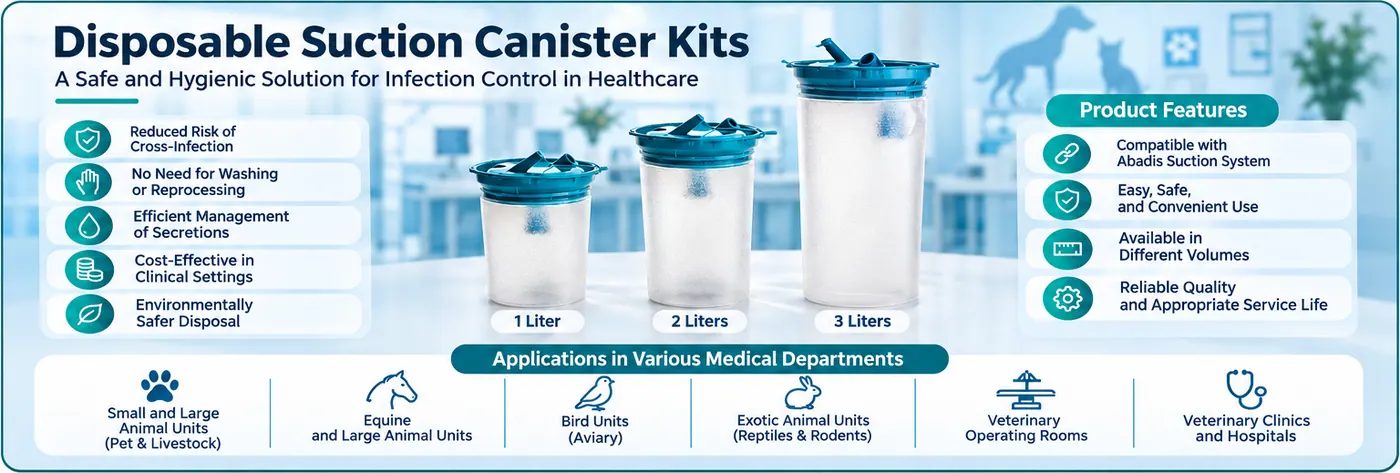
Abadis Med offers disposable suction liners in 1-liter, 2-liter, and 3-liter capacities.
Depending on the product configuration, options such as hydrophobic filters and gelling powder are also available.
This product range allows healthcare facilities to evaluate suitable options according to their operational requirements and the technical specifications of their collection systems.
In veterinary clinics and hospitals, Abadis Med suction liners may be considered for collecting fluids generated during certain treatment and surgical procedures.
Potential benefits in appropriately configured systems include reducing the need for direct fluid emptying, simplifying certain secretion management procedures, and limiting personnel contact with collected fluids.
However, using Abadis Med products with veterinary suction equipment requires verification and confirmation of technical compatibility.
Similarly, claims regarding infection reduction or specific levels of resource savings require reliable, product-specific supporting evidence.
Conclusion
Disposable suction liners are important components of fluid collection systems used in healthcare facilities and may also have applications in veterinary clinics and hospitals.
When used correctly in compatible systems, these products can support more organized management of blood and secretions, reduce certain emptying and cleaning procedures, and limit direct contact between personnel and collected fluids.
Nevertheless, safe operation depends on proper equipment selection, correct installation, performance monitoring, staff training, and adherence to infection control protocols.
By manufacturing disposable suction liners in various capacities, Abadis Med provides products that can be evaluated for use in compatible veterinary fluid collection systems.
Making informed equipment choices can contribute to safer practices and improved hygienic management in veterinary facilities.
Frequently Asked Questions (FAQ)
1. What is a veterinary suction liner, and what is it used for?
A veterinary suction liner is a disposable collection bag used to collect blood, secretions, and fluids generated during animal treatment and surgical procedures. It is placed inside a compatible collection canister and helps facilitate hygienic fluid management.
2. Are disposable suction liners suitable for dog and cat surgery?
Yes. Disposable suction liners may be used during surgical procedures involving dogs, cats, and other companion animals, provided they are compatible with the suction equipment and collection canister. The appropriate capacity should be selected according to the expected fluid volume.
3. What is the difference between a disposable suction liner and a reusable suction canister?
Reusable suction canisters collect fluids directly and generally require emptying, cleaning, and reprocessing after use. Disposable suction liners collect fluids inside a removable bag, potentially reducing certain emptying and cleaning procedures.
4. Can disposable suction liners help reduce infection risks in veterinary facilities?
When used correctly in suitable closed systems, disposable suction liners may reduce direct contact with collected fluids and limit opportunities for splashing. However, they do not replace established infection prevention procedures.
5. What is the function of a hydrophobic filter in a suction liner?
A hydrophobic filter helps protect the vacuum pathway against liquid penetration. Depending on its design and technical specifications, it may reduce the risk of fluid overflow into the suction equipment.
6. Are disposable suction liners compatible with all veterinary suction devices?
No. Compatibility depends on the collection canister, lid design, connectors, operating conditions, and technical requirements of the suction equipment. Compatibility should be verified before use.
7. What capacities are available for veterinary suction liners?
Abadis Med disposable suction liners are available in 1-liter, 2-liter, and 3-liter capacities. The appropriate capacity depends on the type of veterinary procedure, anticipated fluid volume, and suction system configuration.
8. Can disposable suction liners reduce water and disinfectant consumption?
In suitable collection systems, disposable liners may reduce the need for direct internal canister cleaning, potentially lowering water and disinfectant consumption. Actual savings depend on the facility’s cleaning procedures and operating conditions.
References
- Stull, J. W., et al. (2018). 2018 AAHA Infection Control, Prevention, and Biosecurity Guidelines. Journal of the American Animal Hospital Association, 54(6), 297–326.
- Sturgeon, C., Lamport, A. I., Lloyd, D. H., & Muir, P. (2000). Bacterial contamination of suction tips used during surgical procedures performed on dogs and cats. American Journal of Veterinary Research, 61(7), 779–783.
- International Organization for Standardization. (2021). ISO 10079-4:2021 — Medical suction equipment — Part 4: General requirements.
- American Animal Hospital Association (AAHA). (2018). Overview of Infection Control, Prevention, and Biosecurity Procedures.
- American Animal Hospital Association (AAHA). (2018). Infection Control Strategies.